How to Read the Ranges
How much pistachio paste makes a pistachio gelato? How much lemon juice does a sorbet need? Every flavor has an amount where it tastes clearly of itself without taking over the recipe. This guide gives typical dosing ranges for the most common flavors, grouped into families, and explains what each family does to the balance of your recipe.
All amounts are a percentage of the mix weight: 10% means 100 g in 1 kg of mix. In the Recipe Editor this is the W% column, and you can type a percentage straight into it. If the column isn't shown, add it with Customize Table Columns. See Recipe Editor.
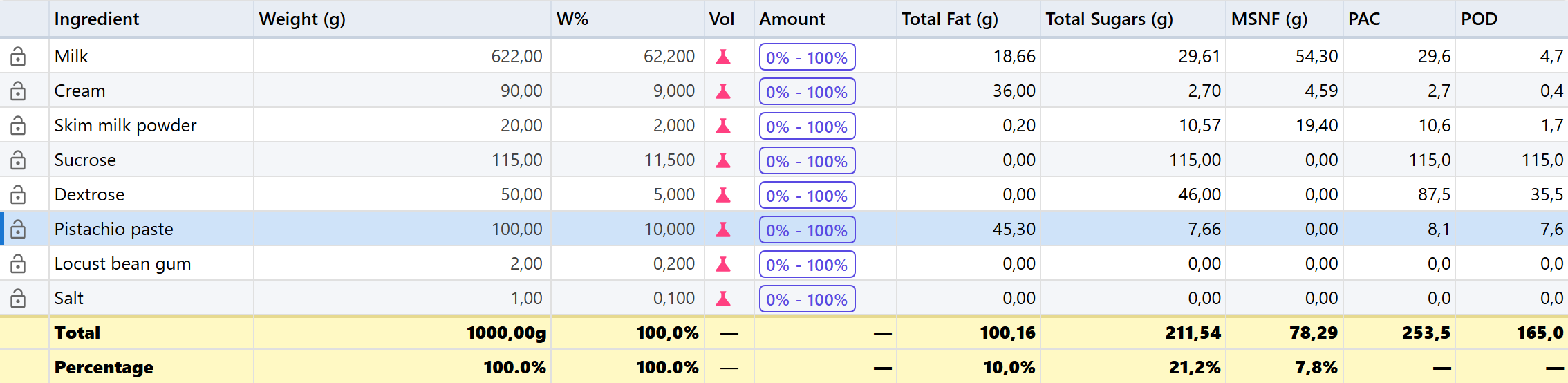
The low end of a range gives a mild, rounded flavor. The high end gives an intense one. Where you should land depends on a few things:
- The ingredient itself. A dark-roasted hazelnut paste is stronger than a light one, ripe fruit is stronger than unripe, and extracts differ a lot between brands.
- Fat. Fat carries richness but mutes delicate flavors. A rich ice cream needs a higher dose than a lean gelato for the same impression.
- Serving temperature. Cold dulls taste. Ice cream served from a hard freezer needs more flavor than gelato served warmer.
- Air. More overrun means less mix, and less flavor, in every spoonful.
The ranges are practical starting points for typical ingredients, not fixed rules. Commercial pastes, extracts and flavor concentrates can need very different amounts: when the manufacturer gives a dose, start from that.
Tip: Judge the dose on the finished ice cream, at the temperature you serve it. A mix that tastes right warm or from the fridge tastes weaker once it is frozen. Begin in the middle of the range, taste the result, and adjust the next batch.
Flavor Families at a Glance
| Family | Typical range | What it brings to the recipe |
|---|---|---|
| Pure nut pastes | 8–15% | Fat and solids |
| Sweetened nut pastes (praline, gianduja) | 12–20% | Fat, solids and sugar |
| Seed pastes (sesame) | 6–10% | Fat and solids |
| Chocolate and cocoa | 5–22% | Fat, solids, sugar and bitterness |
| Strong fruit | 20–35% in sorbet, 10–20% in dairy | Water, acid and some sugar |
| Medium fruit | 35–50% in sorbet, 20–30% in dairy | Water and fruit sugars |
| Mild fruit | 50–70% in sorbet, 25–40% in dairy | A lot of water, fruit sugars |
| Vanilla, extracts and aromas | 0.1–1.5% | Almost nothing |
| Coffee and tea | 1–10% | Bitterness; espresso adds water |
| Caramel, honey and syrups | 3–25% | Sugar: sweetness and softness |
| Dairy flavors (yogurt, mascarpone) | 10–50% | Replace part of the milk and cream |
| Spices and herbs | 0.1–4% | Almost nothing |
| Alcohol | 1–5% | A much softer ice cream |
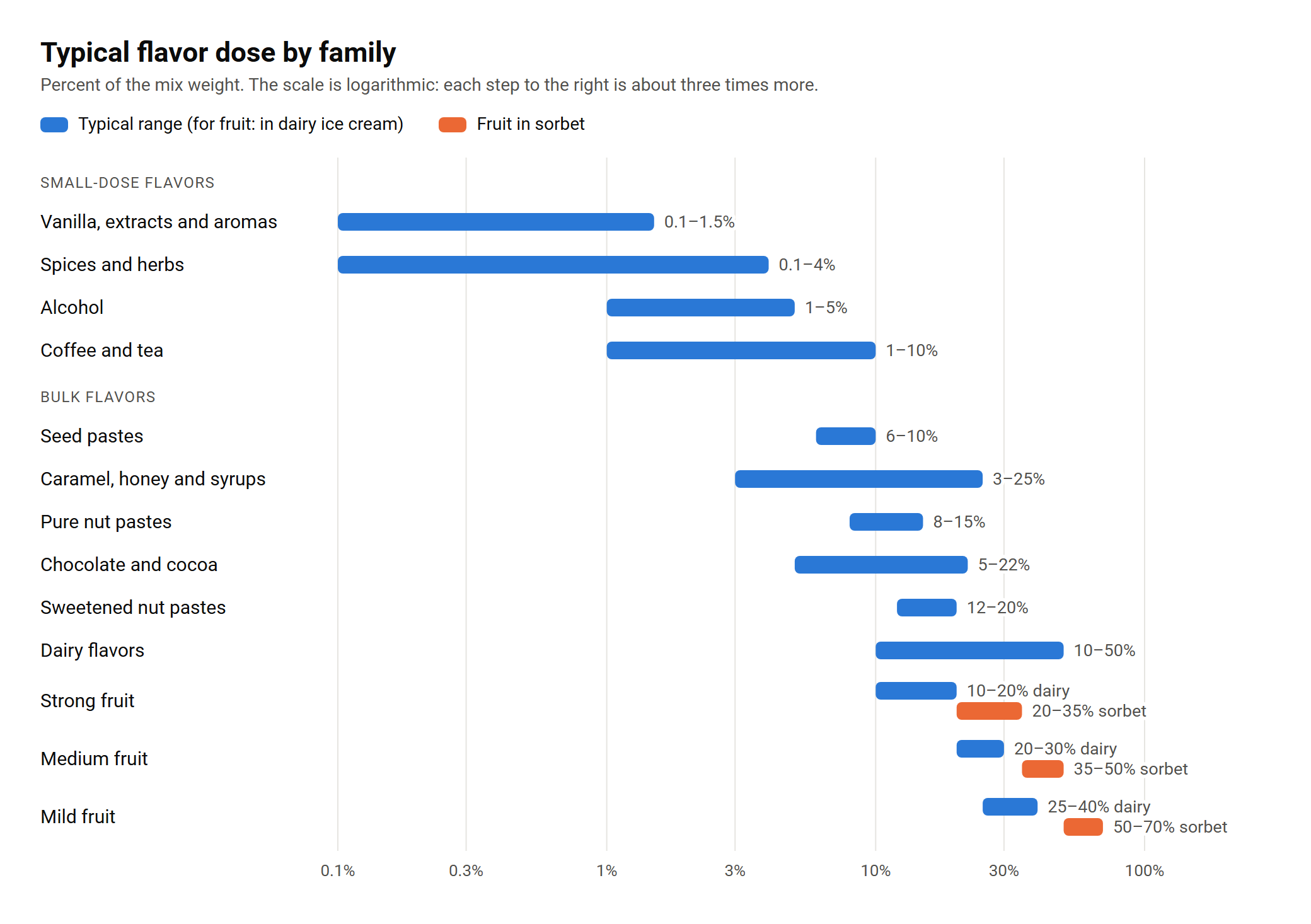
The families fall into two kinds. Small-dose flavors such as vanilla, spices, extracts and infusions hardly change the composition, so the base recipe stays as it is. Bulk flavors such as nut pastes, chocolate, fruit and yogurt make up a large part of the mix and bring their own fat, sugar, water or solids. With those, the rest of the recipe has to make room.
Nut and Seed Pastes
Nut flavors come from pastes of finely ground, usually roasted nuts. The ranges below are for pure pastes, made of 100% nuts. Check the label: many pastes are sweetened or blended with other fats, and those need a higher dose for the same flavor.
| Ingredient | Range (% of mix) | Notes |
|---|---|---|
| Pistachio paste | 8–12% | A delicate flavor. A pinch of salt lifts it. |
| Hazelnut paste | 8–12% | Roasting makes it strong. Use the low end for dark roasts. |
| Peanut paste or peanut butter | 8–12% | Peanut butter often contains salt and sugar. |
| Pine nut paste | 8–12% | |
| Almond paste (pure almonds) | 10–14% | Milder. Not the same as marzipan, which is mostly sugar. |
| Walnut or pecan paste | 10–15% | Mild and slightly bitter. |
| Sesame paste (tahini), black sesame | 6–10% | Strong and slightly bitter. |
| Praline paste, gianduja, nougat paste | 12–20% | Part sugar, often around half, so they need a higher dose. Check the label. |
What it does to the recipe: nut pastes are roughly half fat or more, so 10% paste adds several percent fat to the mix. Use less cream to make room for it. Sweetened pastes also bring sugar, so the other sugars go down as well. Nuts make ice cream feel firmer than their numbers suggest; the calculator takes this into account in the serving temperature. See Understanding Scoopability and Serving Temperatures.
Chart: Ice Cream Chocolate and Nuts, or Gelato Chocolate and Nuts.
Chocolate and Cocoa
Chocolate flavor comes from cocoa powder, from chocolate, or from both together. Cocoa powder gives a deep, dry cocoa taste. Chocolate adds cocoa butter, which gives a rounder taste and a denser texture.
| Ingredient | Range (% of mix) | Notes |
|---|---|---|
| Cocoa powder | 5–10% | Used alone. Above 10% the mix gets thick and dry-tasting. |
| Dark chocolate (60–75% cocoa) | 8–18% | |
| Milk chocolate | 12–22% | Milder, and about half sugar. |
| White chocolate | 12–22% | Cocoa butter, milk and sugar. Mild and very sweet. |
When you combine cocoa powder and chocolate, use the lower half of each range, for example 4% cocoa powder with 8% dark chocolate.
What it does to the recipe: chocolate brings fat, sugar and solids, and cocoa powder brings even more solids. That leaves less room for dairy, which makes chocolate the hardest family to balance. Bitterness also calls for a little more sweetness. Balancing for Different Ice Cream Types shows how to set it up.
Chart: Ice Cream Chocolate and Nuts, or Gelato Chocolate and Nuts.
Fruit
Fruit differs more than any other family. A lemon sorbet tastes clearly of lemon with a quarter of the mix as juice, while a watermelon sorbet needs almost three times as much fruit. It helps to sort fruit into three groups by how strong it tastes.
The amounts are for prepared fruit: juice for citrus, and purée or pulp without peel, stones and cores for everything else.
| Group | Fruits | In sorbet | In dairy ice cream |
|---|---|---|---|
| Strong (acidic or very aromatic) | Lime, lemon, yuzu, passion fruit, blackcurrant | 20–35% | 10–20% |
| Medium | Raspberry, blackberry, blueberry, cherry, apricot, mango, pineapple, banana, orange, mandarin, grapefruit, lychee, fig | 35–50% | 20–30% |
| Mild (watery or delicate) | Strawberry, peach, pear, apple, kiwi, grape, papaya, melon, watermelon | 50–70% | 25–40% |
Within a group, the more acidic and aromatic fruits sit at the low end: lime below lemon, raspberry below mango. Melon and watermelon sit at the very top of the mild group. With lemon and lime, the acidity limits the dose as much as the flavor does: more juice needs more sweetness to stay pleasant.
A few things move the dose:
- Sorbet or dairy. A sorbet is built on the fruit, so it carries much more of it. In a dairy ice cream the milk and cream need their share of the mix, and the fruit dose is about half.
- Cooked or roasted fruit has lost water and is more concentrated, and its flavor changes too. How much less you need depends on how much water it lost: fruit cooked down to three quarters of its weight needs about three quarters of the dose. The Evaporate tool in the Recipe Editor makes a concentrated version of an ingredient for you. See Recipe Weights, Scaling & Evaporation.
- Citrus zest. Much of the citrus aroma is in the peel. Add zest to the juice: see Infused Flavors below.
- Bought purées come both unsweetened and with added sugar, often around 10%. Check the product and use an ingredient that matches it.
Tip: Add acidic juices and purées to the chilled mix, not the hot one. Acid and heat together can curdle the milk proteins. Mark such an ingredient with the E button in the Recipe Editor so that it isn't counted in the evaporation.
What it does to the recipe: fruit is mostly water, with fruit sugars and acid. The water has to be balanced with solids, and the fruit sugars count toward sweetness and softness. Keep the fat on the low side, because fat mutes fresh fruit. See Balancing for Different Ice Cream Types and Sugar Composition.
Chart: Sorbet for water-based recipes; Ice Cream Fruit or Gelato Fruit for dairy recipes.
Vanilla, Extracts and Aromas
These are the smallest doses in the guide, and the ones where a little too much does the most harm. An extract that is overdosed tastes artificial or bitter, so start at the low end.
| Ingredient | Range (% of mix) | Notes |
|---|---|---|
| Vanilla pods | 1–2 pods per kg | Split, scraped and infused in the warm mix. |
| Vanilla extract | 0.5–1% | About 0.5% when you also use a pod. |
| Vanilla bean paste | 0.5–0.8% | |
| Mint extract | 0.1–0.3% | Very potent. Pure peppermint oil is far stronger and is dosed in drops. |
| Almond extract | 0.1–0.5% | Very potent. |
| Other extracts (coffee, lemon, orange) | 0.3–0.8% | Strength varies between brands: check the label. |
| Rose water, orange blossom water | 0.5–1.5% | Quickly turns soapy when overdosed. |
Choose one vanilla source, or a pod with a little extract. Pod, extract and paste together is more than the recipe needs.
What it does to the recipe: almost nothing. The base does all the work, so this is the easiest family to balance.
Chart: Ice Cream Base, or Gelato Base.
Coffee and Tea
| Ingredient | Range (% of mix) | Notes |
|---|---|---|
| Instant coffee | 1–2% | The simplest way: strong flavor, no extra water. Products vary, so start low. |
| Espresso | 5–10% | Adds water. Use less milk to make room for it. |
| Coffee beans, infused | 3–8% | A rounder flavor with little bitterness. See Infused Flavors. |
| Matcha | 1–2.5% | Whisk it into a little of the mix first, to avoid lumps. Above 2% is intense. |
| Loose tea, infused (Earl Grey, chai, jasmine) | 1–2% | Steep briefly: long steeping makes it bitter. |
What it does to the recipe: very little, apart from the water in espresso. Coffee, matcha and tea are bitter, so these flavors often taste best with slightly more sweetness than a vanilla.
Chart: Ice Cream Base, or Gelato Base.
Caramel, Honey and Other Sugar Flavors
In this family the flavor is itself a sugar. It tastes of caramel or honey, and at the same time it sweetens and softens the ice cream like any other sugar.
| Ingredient | Range (% of mix) | Notes |
|---|---|---|
| Honey | 3–8% | Strong honeys such as chestnut or buckwheat: use the low end. |
| Maple syrup | 5–10% | |
| Caramel paste or caramel sauce | 8–15% | A dark caramel is stronger and less sweet than a light one. |
| Dulce de leche | 15–25% | Also brings milk solids. |
| Salt, for salted caramel | 0.1–0.3% | Salt also softens the ice cream a little. |
What it does to the recipe: these ingredients replace part of the other sugars, they don't come on top of them. Honey consists mostly of glucose and fructose, which soften the ice cream more than ordinary sugar does. Set the flavor dose first and let the balancer reduce the other sugars around it.
If you make your own caramel or sauce, you can enter it as a recipe and use that recipe as an ingredient. See Using a Recipe as an Ingredient.
Chart: Ice Cream Base, or Gelato Base.
Dairy Flavors
Yogurt, mascarpone and fresh cheeses are both flavor and base. They are used in large amounts and take the place of part of the milk and cream.
| Ingredient | Range (% of mix) | Notes |
|---|---|---|
| Yogurt | 30–50% | Add it to the chilled mix to keep the fresh, tangy taste. |
| Ricotta | 20–30% | Blend well for a smooth mix. |
| Cream cheese | 15–25% | Usually contains salt. |
| Mascarpone | 10–25% | Very high in fat: it replaces most of the cream. |
What it does to the recipe: each of these brings fat, milk solids and water in its own proportions. Add the flavor ingredient at the dose you want, then let the balancer adjust the milk, cream and milk powder around it. Ingredients added after heating get the E button so that they aren't counted in the evaporation.
Chart: Ice Cream Base, or Gelato Base.
Spices and Herbs
| Ingredient | Range (% of mix) | Notes |
|---|---|---|
| Ground cardamom | 0.1–0.3% | |
| Ground cinnamon | 0.2–0.5% | |
| Ground ginger | 0.2–0.5% | Fresh ginger: 1–3%, infused. |
| Liquorice powder | 1–3% | Strength varies a lot between products. |
| Soft fresh herbs (mint, basil) | 1–4% | Infused and strained out. |
| Woody herbs (thyme, rosemary) | 0.3–1% | Infused. Strong: start low. |
Ground spices stay in the mix. Whole spices and herbs are infused and strained out: see Infused Flavors below.
What it does to the recipe: almost nothing. Spices are easy to overdose, and you can't take them out again, so start at the low end.
Chart: Ice Cream Base, or Gelato Base.
Alcohol
| Ingredient | Range (% of mix) | Notes |
|---|---|---|
| Spirits, about 40% alcohol (rum, whisky, brandy) | 1–3% | |
| Liqueurs, 15–30% alcohol | 2–5% | Also bring sugar. |
| Wine, sparkling wine, beer | 10–20% | Mostly in sorbets. |
What it does to the recipe: alcohol lowers the freezing point far more than sugar does, so a small amount makes the ice cream much softer. That is what limits the dose, not the taste. The calculator counts the alcohol in the softness of the recipe, so balance for the serving temperature as usual and the other ingredients are adjusted to make up for it. There is a limit to that: with a lot of alcohol, the recipe can't reach the serving temperature without giving up sweetness or body. If the balancer can't get there, lower the alcohol dose. See Freezing Point Depression.
Chart: Ice Cream Alcohol, or Gelato Alcohol.
Infused Flavors
An infusion is something you steep in the mix, or in the milk, and then strain out: vanilla pods, coffee beans, tea, herbs, whole spices, citrus zest. The flavor stays and the ingredient leaves. That makes infusions different from every other family: what you weigh in is not what ends up in the ice cream.
| Ingredient | Amount (g per 100 g of mix) | Typical steeping |
|---|---|---|
| Vanilla pods | 1–2 pods per kg | In the warm mix; leave in while the mix matures. |
| Coffee beans, whole or coarsely crushed | 3–8 | Cold, 12–24 hours, or warm, 20–30 minutes. |
| Loose tea | 1–2 | Warm, 3–5 minutes. |
| Soft fresh herbs (mint, basil) | 1–4 | Warm, off the heat, 15–30 minutes, or cold overnight. |
| Woody herbs (thyme, rosemary) | 0.3–1 | Warm, 10–20 minutes. |
| Whole spices (cinnamon sticks, cardamom pods, star anise) | 0.3–1 | Warm, 20–30 minutes. |
| Citrus zest | 0.3–1 | Warm, 15–30 minutes. Fine zest can also stay in. |
| Dried lavender | 0.1–0.4 | Warm, 5–10 minutes. Soapy when overdone. |
| Cocoa nibs | 3–6 | Warm, 20–30 minutes. |
| Toasted nuts, toasted cereal | 5–10 | Warm, 20–30 minutes. |
Time and temperature matter as much as the amount. A warm infusion is fast and extracts more, including bitterness. A cold infusion is slow and usually gives a cleaner, softer flavor. With a new ingredient, taste the mix while it steeps and strain when it is right.
Infusions in the Recipe Editor
Add the ingredient to the recipe, select it, and click the F (Infusion) button. An infusion:
- adds nothing to the calculated composition of the recipe, because it is removed again,
- still counts for allergens and cost,
- does not count toward the mix weight, and shows a dash in the W% column.
Because an infusion has no W%, work out its weight yourself: 1.5% loose tea in 2000 g of mix is 30 g. When you scale the recipe to a new mix weight, the infusions scale with it.
Tip: Coffee beans, herbs and tea leaves soak up liquid and take it with them when you strain. The cleanest way is to infuse in the milk alone, before the other ingredients go in: weigh the milk after straining and top it up with milk to the weight it had before. If you infuse the complete mix, what you lose is mix, and topping up with milk thins the recipe slightly.
Keeping the Dose When You Balance
The flavor dose is your decision. The balancer's job is to adjust everything else around it. Set the dose first, then protect it:
- Add the flavor ingredient and set its amount. To work in percent, click its W% value and type the percentage.
- Click Balance. In the Smart Balance dialog, set the flavor ingredient to Flav. The balancer then keeps it within 5% of its current weight.
- If you want exactly that amount, lock the ingredient instead.
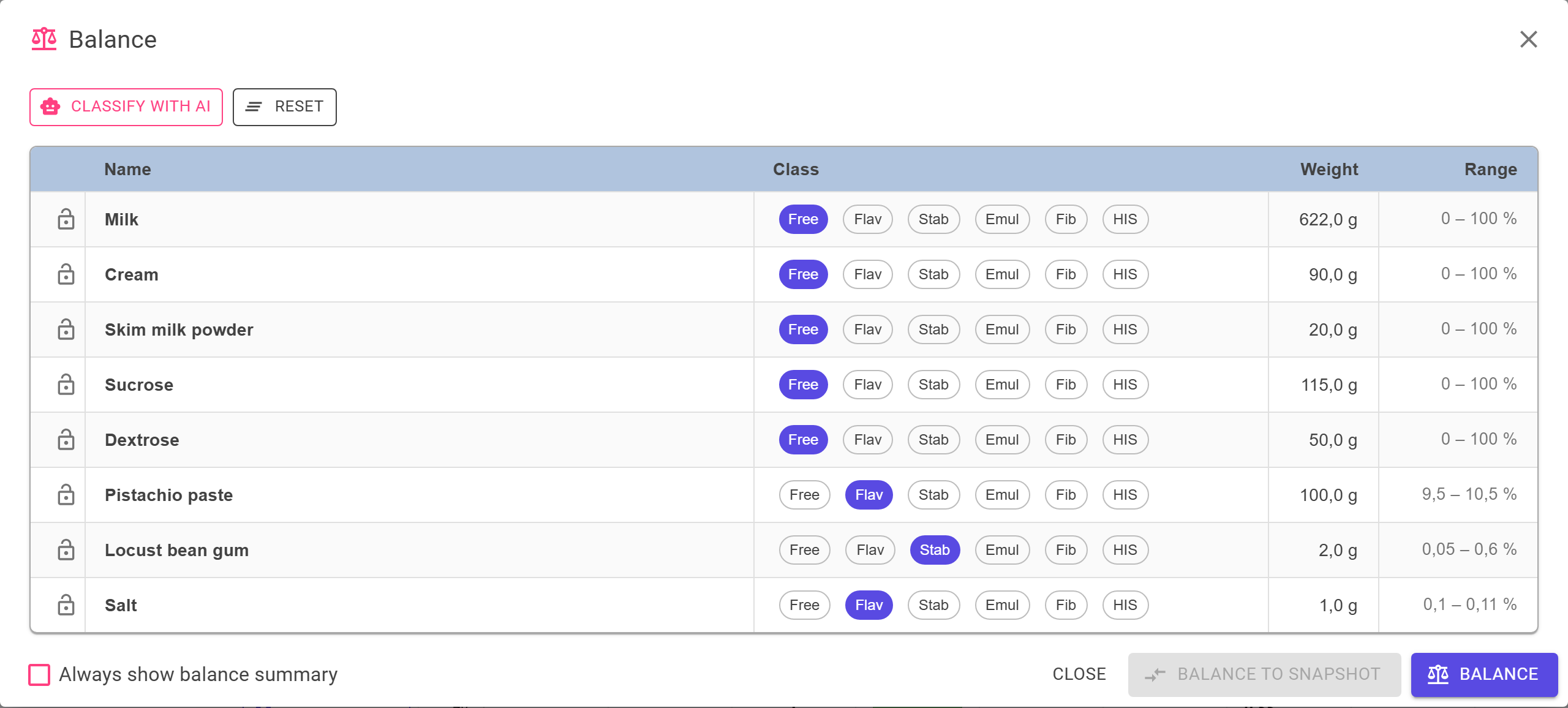
If you would rather give the balancer a range of your own, such as 8–12% for pistachio paste, set it with the Amount button in the Recipe Editor and leave the chip on Free. See Balancing.
If you don't have a recipe to start from, the AI Recipe Generator can suggest one for the flavor you have in mind. Adjust the flavor dose to your taste and balance again.