What Freezing Point Depression Is
Pure water freezes at 0 °C. Dissolve something in it and the freezing point drops: the dissolved molecules get in the way of water molecules lining up into ice crystals, so the water has to get colder before it can freeze. This effect is called freezing point depression, and it is the reason ice cream can be scooped at all.
Without anything dissolved in it, a dairy mix would freeze into a solid block at freezer temperature. With sugars dissolved in it, part of the water stays liquid even at −18 °C, and that unfrozen water is what keeps the ice cream soft.
The key thing to know is that the effect depends on the number of dissolved molecules, not on their weight. A gram of a small molecule contains more molecules than a gram of a large one, so it lowers the freezing point more. That is why dextrose (a small sugar) softens ice cream much more than the same weight of sucrose (a sugar twice its size), and why glucose syrup, which contains many large molecules, softens it less.
What Lowers the Freezing Point in Your Mix
Four groups of ingredients do almost all of the work.
- Sugars and polyols. The main tool. Every sugar is measured against sucrose (table sugar), which is set to 100. This number is the sugar's PAC (from the Italian potere anti-congelante, anti-freezing power).
- Alcohol. Very powerful: gram for gram, ethanol lowers the freezing point about seven times as much as sucrose. When you add a spirit or a liqueur, its alcohol is already part of that ingredient's PAC value, so you don't need to do anything extra.
- Salt. Even more powerful, roughly six times sucrose. Only a pinch fits in most recipes before it changes the taste, but in a salted caramel or a savory ice cream it makes a real difference, and the calculator accounts for it.
- Milk minerals. The minerals in milk solids (part of the MSNF) also lower the freezing point a little. The effect is small, but recipes with a lot of milk powder freeze noticeably colder, so the calculator includes it.
Fat, proteins, fiber and stabilizers have almost no effect on the freezing point: their molecules are huge or they don't dissolve. They still change how hard the ice cream feels, which is covered in Understanding Scoopability and Serving Temperatures.
Common Values
These are the standard reference values, with sucrose as 100. POD is the matching sweetness value (sucrose = 100).
| Ingredient | PAC | POD (sweetness) |
|---|---|---|
| Sucrose (table sugar) | 100 | 100 |
| Dextrose, as bought (monohydrate) | about 175 | about 71 |
| Fructose | 190 | 170 |
| Glucose syrup DE 42 (per dry solids) | 80 | 48 |
| Lactose (milk sugar) | 100 | 16 |
| Salt | 585 | 0 |
| Alcohol (ethanol) | 740 | 0 |
For the difference between pure dextrose and the powder you buy, and what DE means for glucose syrups, see Glucose and Dextrose Explained.
Where these values come from, and how an ingredient gets its PAC and POD, is explained in How PAC and POD Are Calculated.
From Recipe to Freezing Point
To predict how your ice cream behaves, the calculator adds up everything in the recipe that lowers the freezing point, expressed as sucrose equivalents. It then looks at how much water that is dissolved in, and converts the result into the temperature where the first ice crystals form: the freezing point of the mix.
The water matters as much as the sugar. The same amount of sugar in less water makes a stronger solution, and a stronger solution freezes at a lower temperature. Two recipes with the same PAC can therefore have different freezing points: the one with more solids (and so less water) freezes colder and is softer at the same temperature.
The PAC Figures in Your Recipe Data
Open a recipe in the Recipe Editor and click Data beside the chart (on a phone, the data icon in the button row under the chart). The Overview shows PAC se and the freezing point under Sweetness & Freezing. The Freezing & PAC chip lists all of them:
| Property | What it tells you |
|---|---|
| PAC se | The freezing power of your ingredients (sugars, polyols and alcohol) as sucrose equivalents, relative to the whole mix. A mix with 18% sucrose and nothing else sweet has a PAC se of about 180. This is the number most recipes and books quote. |
| PAC normalized | The same, but relative to the water in the mix. Better for comparing recipes with different solids levels. |
| PACtot | PAC se plus the effect of salt. |
| PACtot normalized | PACtot relative to the water: the best single PAC figure for predicting texture. |
| Freezing point | The temperature where the first ice forms. It includes everything above plus the milk minerals. |
| FW08 … FW16 | How much of the water is frozen at −8 °C, −9 °C and so on down to −16 °C. Useful when you know the temperature of your freezer or display cabinet. |
For every other property in the dialog, see Recipe Data Calculation System.
Why Ice Cream Keeps Freezing as It Gets Colder
The freezing point is only where freezing starts. When the first ice forms, it is made of pure water: the sugar stays behind in the water that is still liquid. That remaining water now holds the same sugar in less water, so it is a stronger solution with a lower freezing point. To freeze more of it, the temperature has to drop further. And as more ice forms, the solution gets stronger still.
For a typical ice cream mix, the numbers look roughly like this:
| Water frozen | Sugar in the liquid water | Approximate temperature |
|---|---|---|
| 0% (first ice) | as in the mix | about −3 °C |
| 50% | twice as concentrated | about −6 °C |
| 75% | four times as concentrated | about −14 °C |
This is why your ice cream machine can never freeze the mix solid: it typically stops at around −5 to −7 °C, with roughly half the water frozen. The rest freezes during hardening in the freezer, and even at −18 °C a good recipe still has a share of liquid water left, which is what makes it scoopable.
The calculator repeats this step by step for your recipe and draws the result as the freezing curve: how much of the water is frozen at each temperature. Your serving temperature is read from that curve, at the frozen water percentage you aim for (by default 75% for ice cream and 69% for gelato). How to read the curve and the serving temperatures is explained in Understanding Scoopability and Serving Temperatures.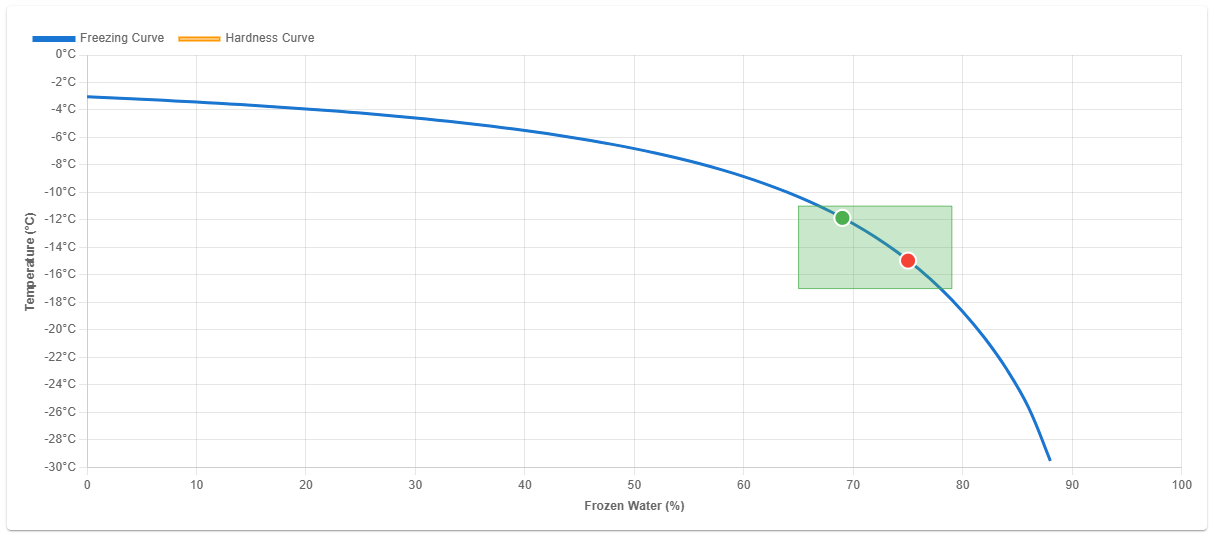
Softer Without Sweeter: Choosing Sugars
Sugar does two jobs at once: it sweetens (POD) and it softens (PAC). If your ice cream is too hard but already sweet enough, adding more sucrose is no answer, because it would make it sweeter too. Changing the type of sugar lets you move the two apart.
The examples below show only the sugars in 1000 g of mix. All three are equally sweet (POD about 180).
| Sugars | Total sugar weight | POD | PAC |
|---|---|---|---|
| A. Sucrose 180 g | 180 g | 180 | 180 |
| B. Sucrose 137 g + dextrose 60 g | 197 g | 180 | 242 |
| C. Sucrose 118 g + dextrose 40 g + fructose 20 g | 178 g | 180 | 226 |
- A is the baseline.
- B swaps part of the sucrose for dextrose. Dextrose is less sweet, so you need a little more of it, but it softens far more: the same sweetness with about a third more freezing power. The extra 17 g of sugar also adds solids, which is usually welcome.
- C adds a little fructose, which is both sweeter and softer than sucrose. It gets most of the way to B's softness while using slightly less total sugar than A.
Going the other way, glucose syrup or glucose powder adds body and solids with little sweetness and less softening than sucrose, which is useful when a recipe is too soft or too sweet.
Tip: Sucrose, dextrose and a glucose syrup or powder are enough for almost every recipe. Fructose is powerful but rarely necessary.
Let the Calculator Do It
You rarely need to work this out by hand:
- The Scoopability Bar in the Recipe Editor has − and + buttons that make the recipe softer or harder while keeping sweetness and solids close to where they are. The POD box next to it does the same for sweetness.
- Smart Balance balances the whole recipe against a chart, including serving temperature and sweetness. See Balancing.
- For the most accurate PAC and POD, record the sugar composition of your ingredients. See Sugar Composition.