
It can be a bit confusing when you read professional ice cream and gelato recipes for the first time. They usually contain dextrose or glucose, and then you google a little and find out that dextrose is glucose, and now you really do not understand what is what or why two different names are used.
The short version is this. When you see glucose in an ice cream recipe, it means some kind of glucose syrup or glucose powder. When you see dextrose, it means pure glucose. The confusion comes from the fact that in chemistry glucose is a single sugar molecule, a monosaccharide, but in the food industry "glucose syrup" is the name of a sweetener made from broken-down starch, which contains a whole mixture of things and only some of it is actual glucose.
In this article I will go through all of them, and at the end explain something that trips up a lot of people: why the sugar figure the calculator gives you for a glucose syrup is lower than the one in your recipe book.
Glucose
Glucose in the chemical sense is a monosaccharide — a single sugar molecule, the simplest building block. You can read more about it on Wikipedia.
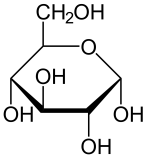
This matters for ice cream because the size of a sugar molecule is what decides how much it lowers the freezing point. Small molecules like glucose are very effective at it. Long chains of glucose molecules stuck together are not. Everything below follows from that one idea.
Glucose syrup
Glucose syrup is made by breaking down the starch in corn, and sometimes wheat, potatoes or rice, into smaller sugars. The process is called hydrolysis, and it uses either enzymes or acid to cut the very long starch molecules into shorter pieces. The result is then filtered and purified.
The important thing to understand is that this cutting is never uniform. You do not end up with a syrup of one single sugar. You end up with a mixture: some single glucose molecules, some pairs (maltose), some triples (maltotriose), and a lot of longer chains. How far the cutting went is what the DE number tells you, and I will come back to that.
Glucose syrup is used a lot in food manufacturing because it does several useful things at once. It stops sugar from crystallising, it improves texture and mouthfeel, it holds on to moisture, and it adds bulk. You will find it in candy, desserts, baked goods, ice cream, drinks and processed food generally.
Glucose syrup is less sweet than pure glucose, because the maltose and the longer chains in it are much less sweet than glucose on its own. The longer the chains, the less sweetness they contribute.
Glucose syrup normally comes in two variants for our purposes, DE 40 and DE 60. A syrup is typically around 80% solids, so roughly a fifth of what you weigh out is water.
Glucose powder
Atomized glucose, also called powdered glucose or glucose powder, is glucose syrup with the water removed. It is made by spray drying: a concentrated syrup is sprayed into fine droplets and dried with hot air, leaving a fine white powder.
It is the same material as the syrup, just dry — usually around 95% solids. That makes it easier to store and ship, and it is why powders exist in many more DE grades than syrups do. If you compare a DE 40 syrup and a DE 40 powder, they contain the same mixture of sugars in the same proportions. The powder simply has less water diluting it.
Dextrose Equivalent (DE)
Dextrose equivalent, or DE, describes how far the starch has been broken down. It is measured by comparing the syrup's reducing power against pure dextrose, which is set at 100.
It is worth being clear about what the number does not mean, because this is a common misunderstanding. DE 40 does not mean that 40% of the starch is still intact. Almost none of it is. Every chain in the syrup, long or short, has one reducing end, so what the measurement really picks up is the average chain length of what came out of the process. A low DE means long average chains. A high DE means short ones. A DE of 100 would mean everything has been cut down to single glucose molecules.
So a DE 40 syrup is not 40% converted starch. It is a fully broken-down syrup whose chains happen to average out fairly long. In practice a DE 40 contains roughly 30% single and double sugars, and around 70% maltotriose and longer chains, measured on its dry substance.
If the DE is below 20, the product is no longer called a glucose syrup at all — it is called maltodextrin. The chains are long enough that it is barely sweet, and in ice cream it is used mainly as a bulking agent to add solids and body without adding sweetness or lowering the freezing point much.
What DE means in practice
Once you understand that DE is about chain length, everything else follows. A higher DE gives you more small molecules, which means:
- More sweetness. Small sugars taste sweeter. A DE 60 is noticeably sweeter than a DE 40.
- More freezing point depression (higher PAC). More separate molecules in the water means a softer ice cream at the same temperature.
- Less viscosity. This one often gets stated backwards. Short chains flow more easily, so at the same solids a DE 60 syrup is thinner than a DE 40. The body, chew and stretch come from the long chains, which means from the low DE end.
So a low DE syrup or a maltodextrin is what you reach for when you want solids and structure without sweetness or softness. A high DE syrup is closer to behaving like ordinary sugar. This is also why two syrups with the same declared solids are not interchangeable — swapping a DE 60 for a DE 40 changes sweetness, hardness and texture all at once, even though the weight on the scale is identical.
Dextrose
Dextrose is the old name for the glucose molecule on its own. It has a DE of 100, because it is pure glucose and there is nothing left to break down.
The form used in ice cream is dextrose monohydrate, which carries one molecule of water for every molecule of dextrose. That water is chemically bound into the crystal, so even though it looks and feels like a dry powder, it is about 91–92% glucose and 8–9% water. That is worth remembering when you enter it in a recipe: it is not quite 100% solids.
Dextrose is very useful in ice cream because it is less sweet than sucrose while lowering the freezing point roughly twice as much. That combination lets you soften a mix without making it sweeter, which is exactly the problem you run into when you try to fix a hard ice cream by adding more sugar. It is one of the most practical tools you have for separating sweetness from hardness.
Why the calculator shows less sugar than your recipe book
This one confuses a lot of people, especially if you work from the Italian gelato manuals such as Caviezel or Cappellini. You put 100 g of glucose syrup DE 40 into a recipe, and the calculator tells you it added 24 g of sugar. The book treats the syrup as 80% solids and counts all 80 g as sugar. So where did the other 56 g go?
Nowhere. It is still there and it is still counted. It is just not called "sugar".
The Total Sugars field in the ingredient database follows the nutrition labelling definition, which counts only mono- and disaccharides: glucose, maltose, fructose, sucrose and lactose. As you now know, most of a DE 40 syrup is maltotriose and longer chains. Those are carbohydrates, and they behave a lot like sugars in your mix, but on a nutrition label they are not allowed to be declared as sugars. Since the app generates labels that have to be legally correct, it has to keep them apart.
The manuals do it differently because they do not need the split. Their tables give one blended POD and PAC value for each syrup grade, so the whole dry substance is simply called zuccheri and the coefficient takes care of the rest. Both approaches are correct. They are just answering different questions.
Here is what a DE 40 syrup actually looks like inside, per 100 g:
| Water | 20 g |
| Glucose and maltose — this is the "Total Sugars" figure | 24 g |
| Maltotriose | 10 g |
| Longer chains | 46 g |
That is the 30% / 70% split from the DE section, seen from the other direction. And it has to be that way: if a syrup really were mostly glucose and maltose, it would measure somewhere around DE 75, not DE 40. A DE 40 glucose powder shows about 29 g of sugar per 100 g, which is the same 30% of its dry weight — same material, less water.
The maltotriose and the longer chains still count in full towards Total Solids, and they still contribute to PAC and POD with their own coefficients. That is why your total solids and your PAC come out much the same as in the book even though the sugar figure looks lower. Only the Sugars readout differs.
Worth knowing: if you use sugar targets taken from the Italian manuals, such as 16–22% total sugars, those assume the book's way of counting. They will look too low against the calculator's Sugars figure as soon as you have syrup in the recipe. Balance against PAC, POD and Total Solids instead — those mean the same thing in both systems.