 Ice Cream Science — The Short Version
Ice cream looks simple: cream, sugar, sometimes egg yolks, sometimes flavoring. Freeze it and eat it. But if you've ever made a batch that came out icy, rock-hard, oddly sweet, or strangely thin, you've already discovered that simple ingredients don't make a simple product.
The key idea to grasp is this: every ingredient in ice cream has two jobs. Sugar tastes sweet — that's the sensory job. But sugar also lowers the freezing point of water, keeping the mix soft enough to scoop — that's the technical job. Cream tastes rich. Cream also coats the tongue and slows the growth of ice crystals. Milk powder adds a mild dairy note. It also binds water and gives the ice cream body.
Once you see ingredients this way, ice cream stops being a recipe and becomes a system. Every choice you make — which sugar, how much fat, how much milk powder — changes both how the ice cream tastes and how it behaves when frozen. You can't adjust one without affecting the other. This article is a short tour of that system — enough to understand why swapping one sugar for another has real consequences, and why the calculator keeps returning to two numbers called PAC and POD.
What ice cream actually is
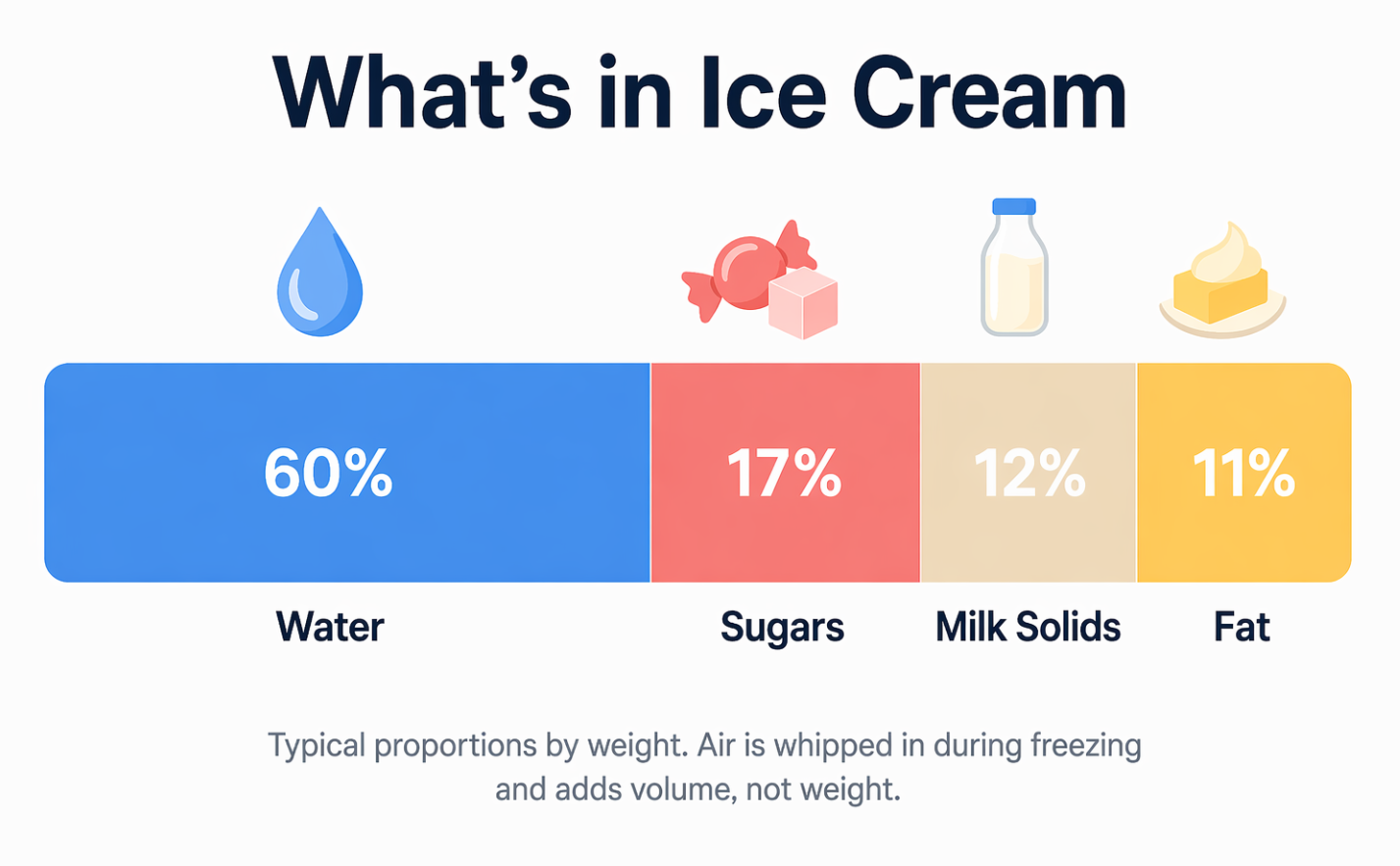
Strip away the flavors and ice cream is mostly two things: water and milk. Everything else — sugar, extra fat, egg yolks, stabilizers — is there in smaller amounts, each doing a specific job.
Now here's the first surprising fact. When you look at a scoop of ice cream at serving temperature, roughly half of what you're looking at isn't ice cream in the way you might picture it. A big chunk is air, whipped in during freezing. Another chunk is unfrozen water — water that's cold, but not cold enough to have turned into ice. The actual frozen part — the ice crystals, the fat droplets, the milk proteins — is scaffolding wrapped around a lot of nothing.
That's what ice cream really is: a frozen foam. Tiny ice crystals, tiny fat droplets, and tiny air bubbles, all held together by dissolved sugars and milk proteins. Get the proportions right and it's smooth and scoopable. Get them wrong and you get a block of flavored ice, or a soupy mess, or something that turns to sand on your tongue.
This is why changing one ingredient matters so much. You're not just adjusting a flavor — you're redesigning a foam.
What ice cream is actually doing
At any moment, a good scoop of ice cream is doing four things at once. It's tasting sweet. It's tasting rich. It's staying soft enough to scoop. And it's holding together as a smooth, stable foam rather than collapsing into a puddle or a block of ice. Each of those things is the work of a different part of the mix.
Tasting sweet
Sweetness is the easy one. Sugar tastes sweet — that's its sensory job, and it's the reason most of us started making ice cream in the first place. The thing worth knowing is that "sugar" isn't a single ingredient. Table sugar, the sugar in honey, the sugar in milk, and the various sugars in syrups and glucose powders all taste sweet to different degrees. Some are noticeably sweeter than table sugar, others are barely sweet at all. The calculator measures the combined sweetness of whatever sugars are in your recipe with a number called POD.
Staying soft
This is the technical job that surprises beginners. Ice cream stays scoopable at freezer temperatures because sugar lowers the freezing point of water. Without sugar, a frozen dairy mix would be a solid block of ice. With enough sugar dissolved in it, some of the water stays liquid even at −18°C, and the ice cream stays soft enough to scoop.
Here's the part that matters: different sugars do this job to different degrees. A spoonful of one kind of sugar might barely soften the mix, while the same spoonful of another kind can make it almost too soft to hold shape. That's why you can't casually swap one sugar for another — you'd be changing two things at once, both the sweetness and the texture. The calculator measures the combined softening power of your sugars with a number called PAC.
Tasting rich and feeling creamy
Richness comes from the milk and cream, and specifically from two things they contain: fat and milk solids.
Fat is what coats your tongue and gives ice cream its characteristic mouthfeel. It's also a quiet structural worker — during freezing, fat droplets partially join together around the air bubbles and form a network that keeps the ice cream smooth rather than icy. Too little fat and the texture turns thin and crystalline. Too much and it can feel heavy or waxy.
Milk solids are everything else in milk that isn't water or fat — mainly lactose (the natural milk sugar), proteins, and minerals. They add a mild dairy note, but their bigger job is holding water in place so it can't form large ice crystals. This is why recipes often call for skim milk powder: it's a concentrated way to add more of these solids without adding more water.
Holding it together
The last job is the least glamorous. Ice cream has to survive — not just the moment it comes out of the machine, but the days and weeks it might spend in a freezer before someone eats it. Three things do most of that work. Stabilizers (used in tiny amounts) thicken the unfrozen water and slow the growth of ice crystals during storage. Emulsifiers — often from egg yolks — help the fat form the network that keeps the texture smooth. And air, whipped in during freezing, makes ice cream light rather than dense, and is part of what makes it feel like ice cream rather than a frozen puck.
None of these are the stars of the show. But without them, the stars can't perform.
The three numbers that matter
If you spend any time in the app, you'll run into three numbers that come up again and again. They're the shorthand ice cream professionals use to describe a recipe's texture, and they correspond directly to three of the four things from the previous section.
POD — how sweet it tastes
POD stands for Potere Dolcificante — Italian for "sweetening power." It's a measure of how sweet your recipe tastes, combining every sugar in the mix into a single number.
The reason POD exists is that the amount of sugar in a recipe doesn't tell you how sweet it will taste. Two recipes with identical total sugar can taste very different depending on which sugars were used. POD does that calculation for you, so you can compare the perceived sweetness of two recipes at a glance, and adjust until the result matches your taste.
PAC — how soft it will be
PAC stands for Potere Anti-Congelante — "anti-freezing power." It measures the combined softening effect of the sugars in your recipe: how effectively they lower the freezing point of water, and therefore how scoopable the ice cream will be at freezer temperature.
A recipe with a low PAC freezes hard. A recipe with a high PAC stays soft — sometimes too soft to hold shape. Between those extremes is a workable range that depends on the style of ice cream you're making and the temperature you plan to serve it at.
PAC is often the first number an experienced maker checks when something goes wrong. Low PAC is a common cause of an icy or rock-hard scoop — though not the only one.
Total solids — how much "ice cream" is in the ice cream
Total solids is simply everything in the recipe that isn't water. Sugar, fat, milk solids, stabilizers — all of it added together.
It matters because water is what freezes, and everything else is what gives ice cream its body and character. A recipe with low total solids has a lot of water to turn into ice, and tends to feel thin and crystalline. A recipe with high total solids feels dense, chewy, and rich — up to a point, beyond which it starts to feel heavy or even pasty.
Most ice cream styles land somewhere between roughly 36% and 46% total solids. But total solids is only part of the picture — it tells you how concentrated a recipe is, not whether those solids are well balanced between sugar, fat, and milk solids. A recipe can hit a reasonable total solids number and still be poorly proportioned.
How these three relate to each other
POD, PAC, and total solids aren't independent dials you can turn one at a time. They're entangled, because the same ingredients affect more than one of them.
Sugar, for example, contributes to all three: it adds sweetness (POD), it softens (PAC), and it counts as a solid (total solids). So when you change the amount or type of sugar in a recipe, all three numbers move. This is the single most important reason you can't adjust a recipe casually. Pulling one lever pulls the others.
The calculator exists to make this visible. You make the changes; it tells you, in real time, what happened to all three numbers.
Why serving temperature matters
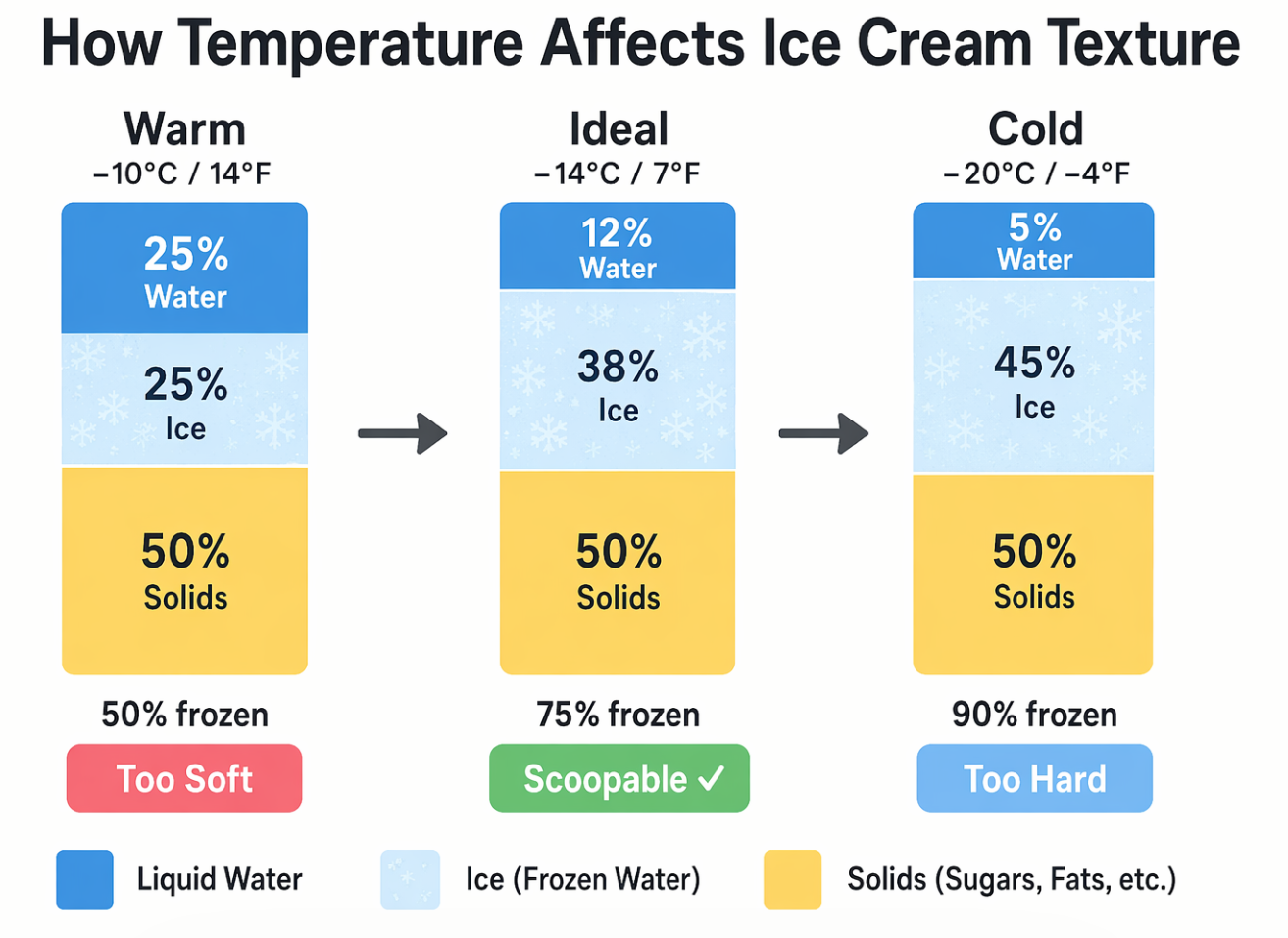
Here's something that surprises almost everyone the first time they hear it: ice cream is never fully frozen. Not at −10°C, not at −18°C, not in your home freezer. At every temperature you'd realistically encounter, some of the water in ice cream is ice, and some is still liquid. The colder it gets, the more of the water has turned to ice, but there's always some unfrozen water left.
This is why serving temperature matters so much. What you actually perceive as "soft" or "hard" is the share of water that's frozen at the moment you scoop. Around 75% frozen water is where ice cream is firm but scoopable with a standard scoop. Around 69% frozen water is where gelato is firm but scoopable with a paddle. Those two targets are why the calculator shows two numbers on every recipe: Serving temp for ice cream, and Serving temp Gelato for gelato.
These are the practical outputs to watch as you build a recipe. A well-balanced ice cream recipe usually has a Serving temp somewhere between −13°C and −16°C. Much warmer and it'll be soft-serve soft straight from the freezer; much colder and it'll be rock hard.
Behind those two numbers is a calculated freezing curve that describes how much water is frozen at every temperature — the mathematical shape of your recipe's behavior. You don't normally need to look at it; the serving temperatures summarize it for everyday use. For more on reading the curve and the scoopability tools, see the dedicated article on scoopability and serving temperatures.
So what now?
If there's one thing to take away from this article, it's that ice cream is a system. Every ingredient has both a sensory and a technical role, and changing any one ingredient changes more than one thing about the result. That's why you can't casually swap sugars, cut the cream in half, or double the milk powder and expect the same ice cream with a minor twist. You'll get a different ice cream — sometimes in interesting ways, sometimes in disappointing ones.
The good news is that you don't have to carry all of this in your head. The calculator tracks POD, PAC, total solids, and the freezing curve for every recipe you build. When you change an ingredient, you can see immediately what happened to each of them, and whether your recipe is still in a sensible range.
A few rules of thumb
Once you've spent some time with a few recipes, the following patterns start to feel obvious. They're worth remembering even so, because they're the quickest way to predict what a change will do before you make it.
- More sugar → softer ice cream. Less sugar → firmer. This is PAC at work.
- More fat → richer, slower to melt. Less fat → leaner, more refreshing, but also more prone to iciness if you go too far.
- More milk solids → denser body and better storage. Too much and the texture turns chalky.
- More water → more ice. More ice means harder straight from the freezer and a higher risk of a coarse, crystalline texture.
- Different sugars behave differently. Swapping one for another changes both how sweet the ice cream tastes (POD) and how soft it is (PAC), usually not by the same amount.
- Serving temperature changes everything. A recipe that's perfect at one temperature can be wrong at another, even though nothing about the recipe itself has changed.
None of these are absolute laws. They're tendencies — the kind of thing that starts as a rule you follow and eventually becomes an instinct you use. The calculator handles the arithmetic. These patterns help you decide what arithmetic is worth doing in the first place.
If you want to go deeper on any of this, the knowledge base has dedicated articles on scoopability and serving temperatures, PAC and POD, freezing point depression, stabilizers and emulsifiers, and more.. But you don't need any of them to start building good recipes. You need to understand what's going on under the hood — and now you do.