The Question
Stabilizers are used in tiny amounts, a gram or two per kilo of mix, so it is fair to ask how much difference they really make, and how much is right. To find out, three batches of the same ice cream were made with different amounts of locust bean gum (LBG), one of the most common ice cream stabilizers, and compared on mix thickness, overrun, taste, texture and melting.
For what stabilizers do and how each one is used, see Stabilizers & Emulsifiers. This article is the hands-on test behind the dosage advice there.
The Setup
The Base Recipe
A plain, unflavored base with three egg yolks, so nothing would mask differences in texture:
| Ingredient | Amount |
|---|---|
| Milk (3% fat) | 410 g |
| Cream (40% fat) | 325 g |
| Skim milk powder | 35 g |
| Egg yolks (3) | 51 g |
| Sucrose | 143 g |
| Dextrose | 35 g |
| Total | 999 g |
Approximate composition, worked out from typical values for these ingredients: about 57% water, 43% total solids, 15.5% total fat, 8.5–9% milk solids not fat (MSNF) and 17.5% added sugars. A rich, fairly dense base.
The Three Samples
The base contains roughly 570 g of water. The LBG was dosed against that water:
| Sample | LBG | % of the water | % of the mix |
|---|---|---|---|
| A | none | 0% | 0% |
| B | 1.45 g | 0.25% | 0.15% |
| C | 2.9 g | 0.50% | 0.30% |
The Method
All three were made the same way: the LBG mixed into the sugar, the mix heated to 85 °C (185 °F) so the LBG could hydrate fully, aged in the fridge for 6 hours, churned in a Musso Stella, and taken out of the machine at about −8 °C (18 °F). The steps are described in How Ice Cream Is Made.
Results
| A: no LBG | B: 0.25% of water | C: 0.50% of water | |
|---|---|---|---|
| Mix after aging | Watery | Thicker | Thickest |
| Overrun | 36% | 42% | 36% |
| Taste | Slightly sweeter | Same as C | Same as B |
| Texture | Light, melts fast in the mouth, flavor gone quickly | A little denser, flavor lingers, smooth | Maybe slightly denser than B, flavor lingers longest, slight cloying film |
| Ice crystals | Smooth, but more noticeable crystals | Fewer, smoother | Fewer, smoother |
| Melting | Slightly faster in the first 10 minutes | About the same as C | About the same as B |
The Mix
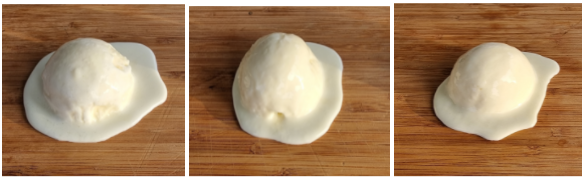
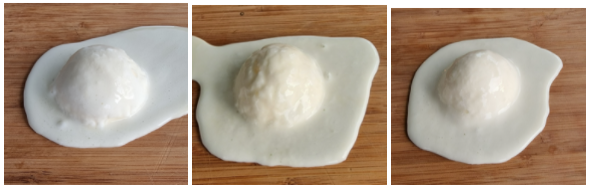
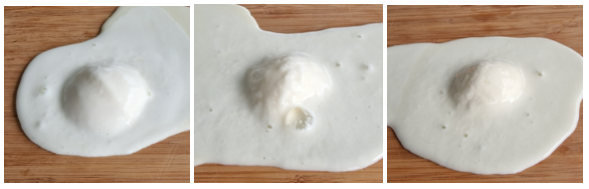
The difference was obvious before churning. Without LBG the aged mix was watery; with 0.25% it had a pleasant, slightly thick body; with 0.50% it was noticeably thick. That viscosity carried through to the finished ice cream and was still visible in the melted puddles afterwards.
Overrun
Sample B took up a little more air than the other two, but with one measurement per batch this is within what you would expect from normal variation. The test does not show that LBG changes overrun much either way.
Taste
The three tasted almost the same, so LBG at these doses does not change the flavor. Sample A came across as slightly sweeter, probably because the thinner ice cream melts faster on the tongue and releases its sugar more quickly.
Texture and Mouthfeel
This is where the stabilizer earned its place. All three samples were smooth, but B and C had fewer noticeable ice crystals than A. Sample A felt light and thin and disappeared almost at once, taking the flavor with it. Sample B was a little denser, and the flavor lingered pleasantly: clearly the best of the three. Sample C lingered longest, but left a slightly cloying, slimy film in the mouth: still better than no stabilizer, but past the ideal.
Melting
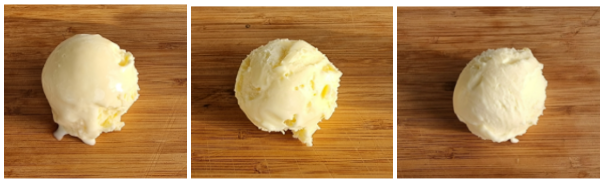
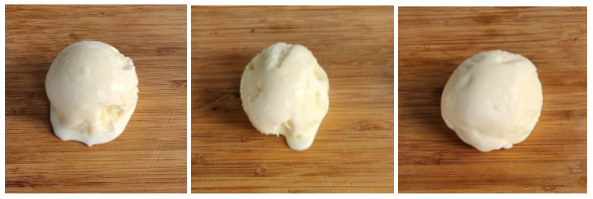
The samples were left to melt side by side and photographed every 10 minutes. Sample A melted slightly faster at first; after that, all three melted at about the same rate.
Conclusion
- A stabilizer clearly helps. Even a small dose of LBG gave a better body, fewer ice crystals, a longer-lasting flavor and slightly slower melting than no stabilizer at all.
- More is not better. Doubling the dose made the mix too thick and gave the ice cream an unpleasant, cloying film.
- About 0.25% of the water weight worked best for this base. Somewhere around 0.30–0.35% might be even better; that was not tested.
Using This in the Calculator
The default charts measure stabilizer against the water, not the whole mix, because a stabilizer works by binding and thickening the water. A recipe with more solids has less water to thicken and needs less stabilizer.
- Stabilizers/Water target. The default charts, such as Ice Cream Base, have a Stabilizers/Water target of 0.2–0.35%, which matches what this test found. When you balance, the calculator keeps the stabilizer within that range. See Balancing for Different Ice Cream Types.
- Stabilizer Ratio tool. In the Recipe Editor, click Tools and choose Stabilizer Ratio. Set the total as % of water and the tool works out the grams. It is described in Stabilizers & Emulsifiers.
- Smart Balance. A pure stabilizer or stabilizer blend starts on the Stab chip, so the balancer can only move it within a sensible dose. See Balancing.
What This Test Doesn't Show
This was a small kitchen test, not a lab study:
- One batch per sample and one overrun measurement each, so small differences, such as B's higher overrun, may be chance.
- One stabilizer. Guar, tara, carrageenan and blends behave differently, and blends usually work better than a single gum.
- No storage test. The ice cream was tasted fresh. Stabilizers matter most during weeks in the freezer and repeated warming and refreezing (heat shock), where they slow the growth of ice crystals. A difference that is small on day one can be large after a month.
- One base. A leaner base with more water, such as gelato or a fruit ice cream, would likely show bigger differences.