What Egg Yolks Do
Egg yolks are one of the oldest ice cream ingredients, and they do several jobs at once:
- Emulsifier. Yolks are rich in lecithin, a natural emulsifier. This is their most important technical job, and only a small amount is needed for it.
- Fat and solids. A yolk is roughly half water, a quarter fat and a sixth protein, so yolks add richness and body.
- Thickener. When heated, yolk proteins thicken the mix, which is what turns a base into a custard.
- Flavor and color. In larger amounts, yolks give the rich, slightly eggy taste and the yellow color of a custard ice cream.
Why Ice Cream Needs an Emulsifier
Milk and cream are already emulsions: tiny fat droplets held in water by milk proteins. They are very stable, which is good for milk but not for ice cream. During churning, the fat droplets need to bump into each other and partly join up around the air bubbles (partial coalescence). That fat network holds the air, makes the ice cream drier and smoother, helps it keep its shape and slows melting.
Whipped cream does this with about 30% fat; ice cream has far less, so it needs help. An emulsifier, such as the lecithin in yolks, loosens the milk proteins' grip on the fat just enough for the network to form. More on emulsifiers in Stabilizers & Emulsifiers.
How Many Yolks?
A yolk weighs about 17–20 g. For a kilo of mix:
| Yolks per kg | What they do | Style |
|---|---|---|
| 0 | Nothing; use another emulsifier such as lecithin | Philadelphia style, egg-free |
| 1–2 | Emulsify; the egg is not tasted | Clean dairy flavor with better texture |
| 3–4 | Emulsify and start to thicken and add richness | Light custard |
| 5–6 and more | Rich, dense, noticeable custard flavor | French style, custard |
Even a quarter to half a yolk per kg contributes some emulsifier, but 1–2 yolks is a practical dose when that is all you want from them. For thickening, other stabilizers usually do the job better and more cheaply.
Yolks in the Calculator
- Emulsifier target. The standard Egg yolk ingredient counts toward the recipe's Emulsifiers value. With it, about four yolks per kg reach the lower end of the Ice Cream Base chart's emulsifier range on their own. With fewer yolks, add a little lecithin or another emulsifier, or accept a value below the range.
- Balancing. Decide on the number of yolks first, then lock them in Smart Balance so the balancer doesn't change them. Put lecithin or another emulsifier on the Emul chip. See Balancing for Different Ice Cream Types.
- Fat. Yolk fat counts toward total fat, but not toward milk fat. A custard recipe has less milk fat at the same total fat.
The Experiment: 0 to 8 Yolks
To see what yolks really change, five ice creams were made with 0, 2, 4, 6 and 8 yolks per kg. All five were balanced to the same targets, so the differences come from the yolks, not from more fat or sugar:
| Target | Value |
|---|---|
| Total fat | 15% |
| Total solids | 42% |
| Serving temp | −15 °C (5 °F) |
| POD | 175 |
| MSNF/Water | 15% |
With more yolks, more of the fat came from the yolks and less from the cream. The stabilizer was reduced as the yolks went up, from 3 g in the egg-free version to 1 g with 8 yolks, and the egg-free version got 3 g of lecithin as its emulsifier. The full recipes are at the end of this article.

Mix Thickness
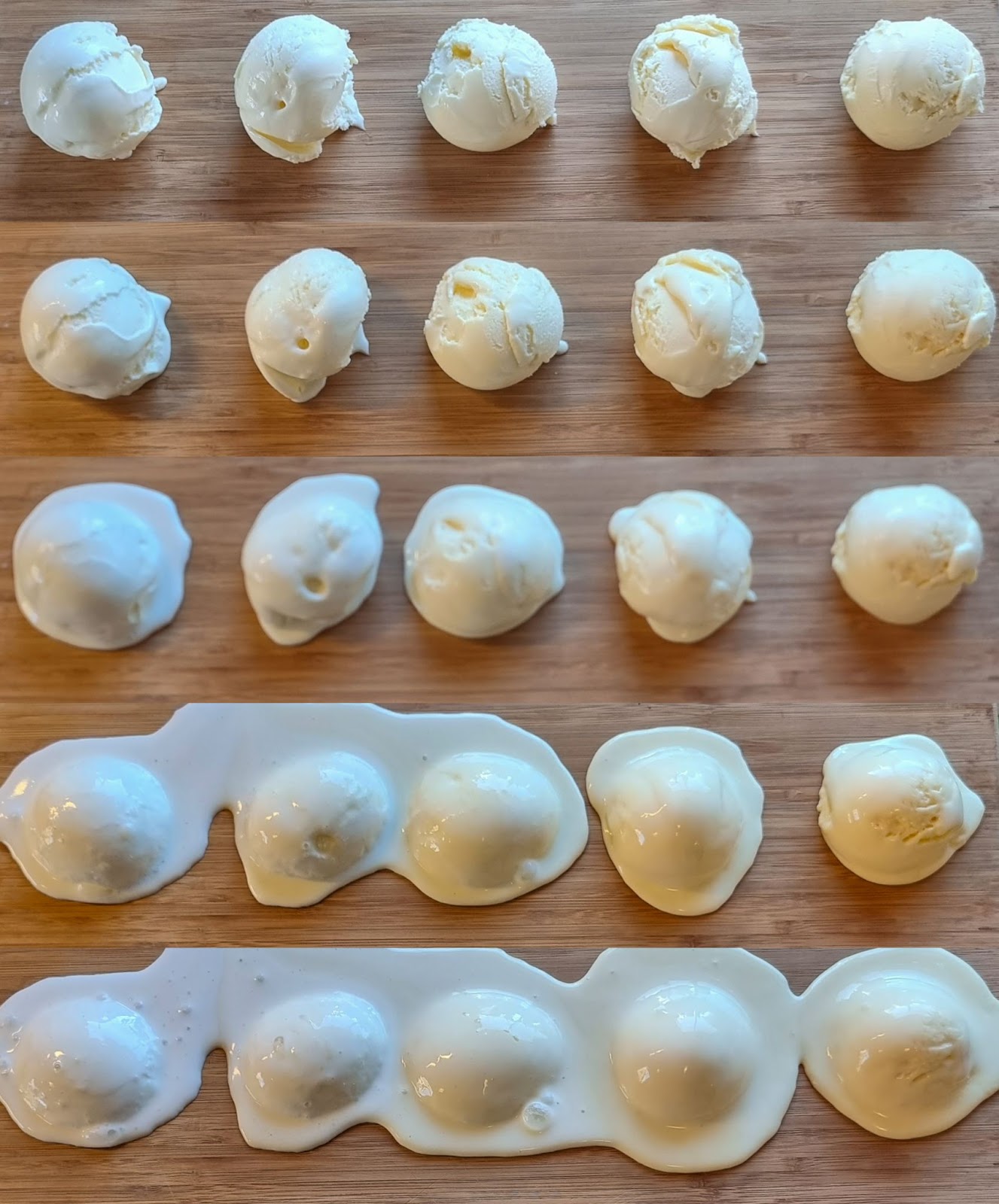
As expected, the aged mix got thicker with every step: the 0- and 2-yolk mixes were watery, the 8-yolk mix was thick.
Overrun
| Yolks per kg | 0 | 2 | 4 | 6 | 8 |
|---|---|---|---|---|---|
| Overrun | 46% | 42% | 40% | 36% | 34% |
Overrun fell steadily as the yolks went up. Since fat and solids were the same in all five, the difference most likely comes from the higher viscosity of the yolk-rich mixes, which take up air less easily in the machine.
Melting
The samples were left to melt side by side and photographed every 10 minutes. The egg-free ice cream melted much faster than the one with 8 yolks. Whether that is the yolks themselves or simply the thicker mix is not clear from this test; a 0-yolk mix thickened with extra stabilizer to the same viscosity would answer that.
Taste
All five had a good texture and taste. In a blind tasting, the 6-yolk version came out on top, but only just; the 0- and 8-yolk versions came last. Even with 8 yolks the ice cream did not taste overly eggy.
What the Test Shows
- There is no single right number of yolks. It depends on the flavor and on what you like. Delicate flavors such as fruit often do better with few yolks; vanilla, coffee and caramel suit a custard.
- More yolks means a thicker mix, less air and slower melting.
- With few or no yolks, replace their work: add another emulsifier, and enough stabilizer to get the body you want.
Like any small kitchen test, this one has limits: one batch per version, a small tasting panel, and no storage test.
Method Notes
All five mixes were made the same way: milk, cream and yolks mixed, the dry ingredients blended in with a hand blender, then heated to 85 °C (185 °F) while stirring constantly, cooled in ice water, aged for 6 hours and churned in a Musso Stella. The general process is described in How Ice Cream Is Made.
- Straining the yolks. For the test, all the yolks were separated, pushed through a fine sieve to remove the membranes, and then weighed out per batch. It is not clear that this makes much difference, but it gives a smoother result and makes weighing easier.
- Don't overcook. Heat until the mix reaches temperature, but avoid holding it at a high temperature for a long time, which can give a cooked-egg taste.
Food Safety
Raw egg yolks can carry salmonella. Heating the base as described above makes it safe; for no-cook recipes, use pasteurized yolks. Advice differs between countries, so read Raw Egg Yolks and Food Safety before you serve ice cream with uncooked eggs.
The Five Recipes
Each recipe is about 1000 g, made with milk at 3% fat and cream at 40% fat.
| Ingredient | 0 yolks | 2 yolks | 4 yolks | 6 yolks | 8 yolks |
|---|---|---|---|---|---|
| Milk (3%) | 446.6 g | 433.3 g | 423.6 g | 414.5 g | 407.0 g |
| Cream (40%) | 341.8 g | 320.5 g | 298.8 g | 279.0 g | 254.9 g |
| Skim milk powder | 32.4 g | 34.0 g | 35.4 g | 36.7 g | 39.2 g |
| Sucrose | 141.0 g | 146.7 g | 146.3 g | 144.2 g | 146.9 g |
| Dextrose | 36.8 g | 31.3 g | 30.9 g | 31.7 g | 31.1 g |
| Egg yolk | 0 g | 34 g | 68 g | 102 g | 136 g |
| Stabilizer | 3.0 g | 2.3 g | 2.0 g | 1.5 g | 1.0 g |
| Lecithin | 3.0 g | – | – | – | – |