What You'll Learn: This guide explains the USDA dialog – a two-step tool for importing ingredients from the USDA Food Data Central database into your Ice Cream Calc ingredient library. You'll learn what USDA FoodData Central is and why it matters for ice cream, how to search for foods, how to review the nutrition data, how to choose the correct food type, and how to preview the calculated ice cream properties before adding the ingredient to your library.
Introduction: What is USDA FoodData Central?
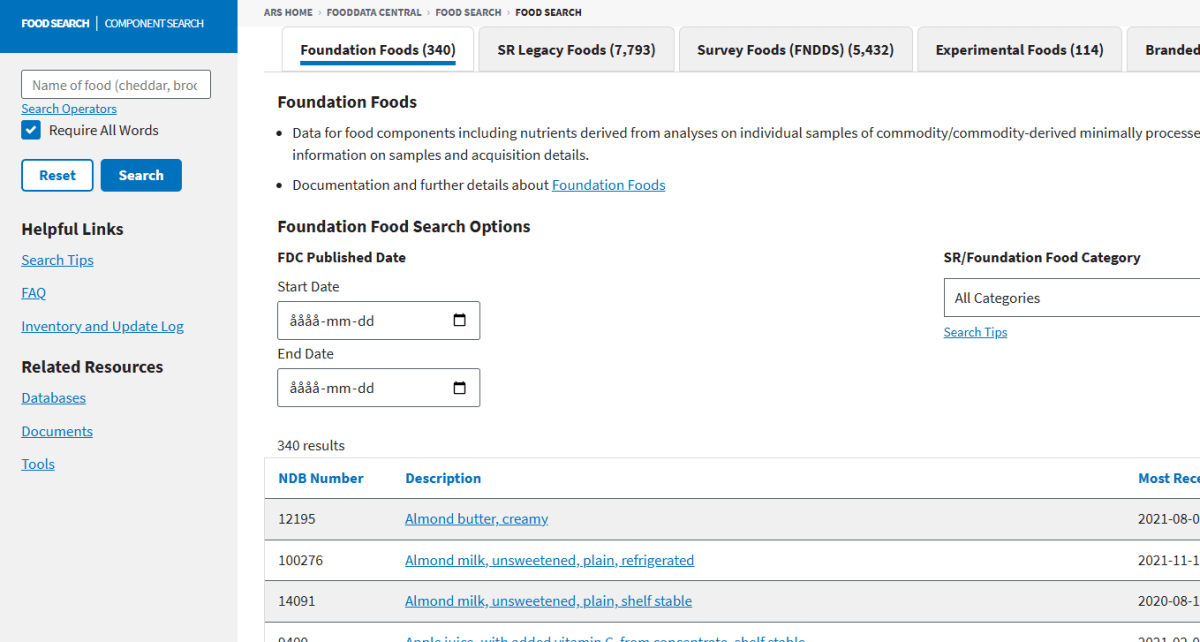
The USDA FoodData Central is the United States Department of Agriculture's comprehensive database of food nutrition information. It contains detailed nutritional data for tens of thousands of foods, from basic ingredients like milk and sugar to complex branded products.
Why Use USDA Import?
The USDA database is incredibly valuable for ice cream makers because:
- Comprehensive data: Contains detailed breakdowns of nutrients that aren't always on product labels
- Reliable source: Government-verified nutritional information
- Sugar breakdown: Often includes individual sugar types (sucrose, glucose, fructose, lactose) which are critical for ice cream calculations
- Free and accessible: No cost to use, available to everyone
- Regularly updated: Database is maintained and expanded continuously
What Makes Ice Cream Ingredients Special?
Here's something critical to understand: standard nutrition labels don't contain the specialized data needed for ice cream formulation.
A typical nutrition label shows:
- Total Fat
- Total Carbohydrates
- Total Sugars
- Protein
- Basic vitamins and minerals
But for ice cream, we need to know:
- PAC (Freezing Point Depression): Not on any label – must be calculated from sugar composition
- POD (Sweetness Power): Not on any label – must be calculated from sugar composition
- Individual sugar types: Rarely on labels (sucrose vs glucose vs lactose vs fructose)
- Milk Fat vs Total Fat: Labels only show "Total Fat" – dairy products need milk fat specifically
- MSNF (Milk Solids Not Fat): Critical for dairy but never on labels
- Cocoa Fat vs Total Fat: Chocolate products need this distinction
- Cocoa Solids: Affects texture and hardening in ice cream
This is why the Food Type selection is so important – it tells the Ice Cream Calculator how to transform basic USDA nutrition data into the specialized ice cream properties you need.
⚠️ Key Concept: The USDA database gives us raw nutritional data. The Ice Cream Calculator uses your Food Type selection to calculate the ice cream-specific properties (PAC, POD, MSNF, etc.) that you won't find on any nutrition label.
How the USDA Dialog Works
The dialog runs in two steps:
- Search Dialog – Find the food you want
- Detail Dialog – Review the data, pick a food type, and add it to your library
Opening the USDA Dialog
The USDA dialog is opened from the Ingredient dialog when you're creating or editing an ingredient. Click the USDA database button to launch it.
You can also reach it from any flow that offers to import ingredient data – for example when adding a new ingredient from scratch and choosing "Import from USDA" as the data source.
Part 1: Search Dialog
The Search Dialog is where you find the USDA food entry you want to import. It uses the same database as the official USDA FoodData Central website, but with a UI tuned for ice cream formulation.

Search Input
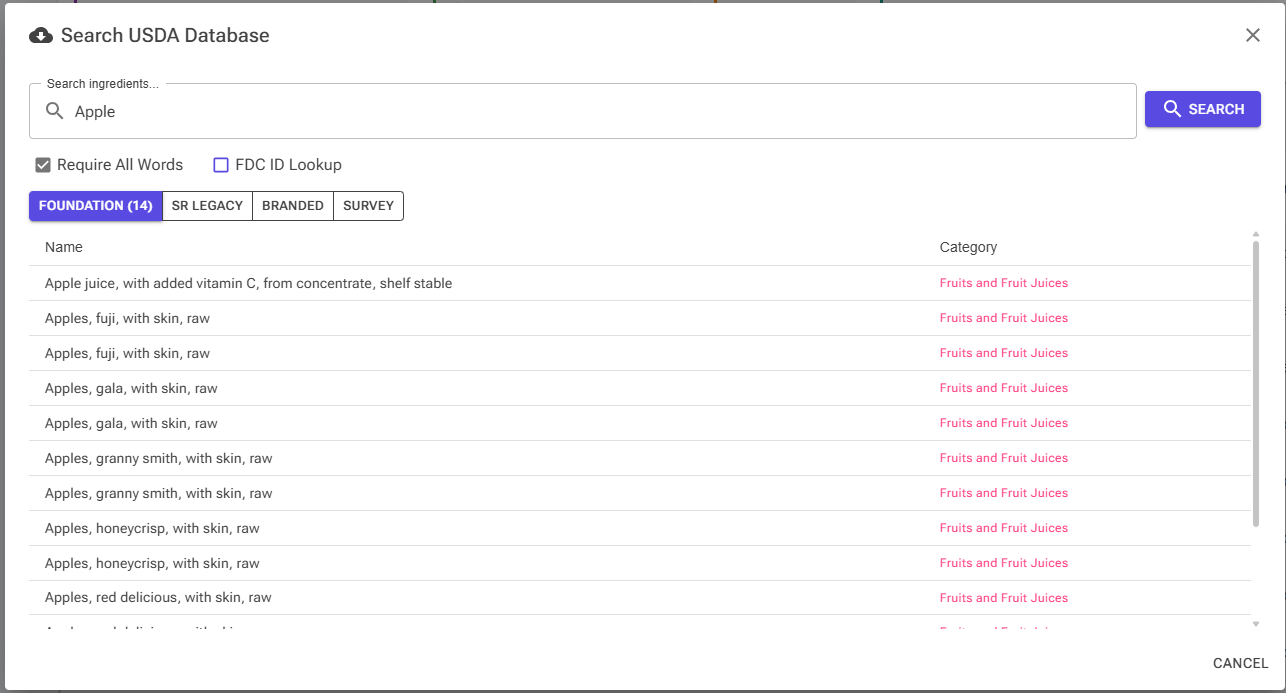
At the top of the dialog you'll find the search field and a Search button. Type a term (e.g. "heavy cream") and press Enter or click Search. The field is focused automatically when the dialog opens, so you can start typing immediately.
Below the search field are two option checkboxes:
- Require All Words – When on, only results containing all of your search terms are returned. Turn off for broader results. Defaults to on.
- FDC ID Lookup – Switches the search mode to direct lookup by FDC ID (see below).
FDC ID Lookup
Every USDA food has a unique FDC ID (Food Data Central ID) – a numeric identifier you can copy from the official USDA website or any other source that references USDA foods.
When FDC ID Lookup is checked:
- The search box label changes to "FDC ID" and expects a number (e.g.
170856) - Type or paste the ID and press Enter
- The Detail Dialog opens directly for that food – skipping the results list entirely
Use this when you already know exactly which food you want and don't need to browse. It's the fastest path to import.
Data Type Tabs
USDA groups foods into several data types. After you run a search, the results are split into four tabs and the result count for each tab is shown in the tab label:
- Foundation – Foods with detailed, analytical nutrient data from USDA research programs. Usually the most complete and reliable.
- SR Legacy – The older "Standard Reference" database. Still widely used and generally reliable for common foods.
- Branded – Commercial branded products (supermarket items). Data comes from manufacturer label claims, so quality varies, but useful for specific brand-name ingredients.
- Survey (FNDDS) – Foods from the USDA's dietary intake survey. Includes many prepared/restaurant-style items.
Where the data comes from: Foundation and SR Legacy results are served from the app's local database, so they're fast and don't count against any API rate limits. Branded and Survey results are fetched live from the USDA API.
Tip: Start with Foundation or SR Legacy when looking for basic ingredients (milk, sugar, cocoa powder, etc.) – the data is more reliable and more detailed. Use Branded only when you need a specific commercial product.
Filters
When a tab has multiple categories (or brands, for the Branded tab), filter dropdowns appear above the results table:
- Category – Narrow results to a specific USDA food category (e.g. "Dairy and Egg Products")
- Brand (Branded tab only) – Narrow results to a specific manufacturer
Both filters have a clear button. If filters hide all your results, an inline "Clear filters" link appears so you can reset them quickly.
Results Table
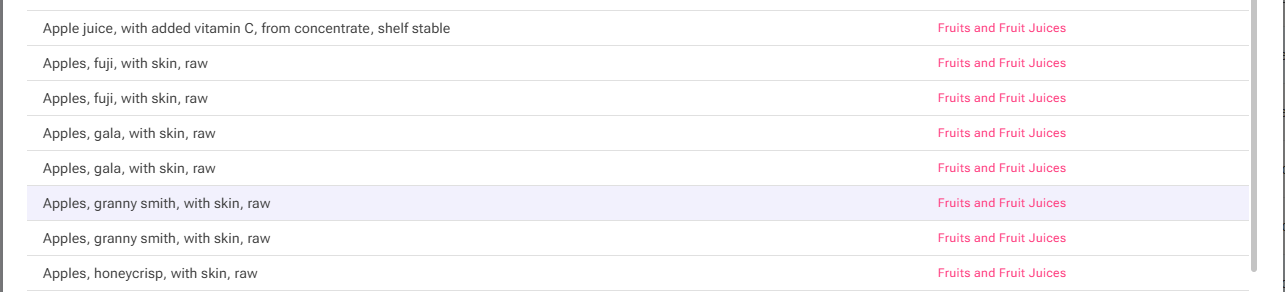
Each row shows:
- Name – The food description from USDA
- Category – USDA food category
- Brand – Manufacturer (Branded tab only)
Click any row to open the Detail Dialog for that food.
Pagination
Results are paginated 25 per page. When there are more results, a pagination control appears below the table. Changing page loads the next batch (from the local DB for Foundation/SR Legacy, from the USDA API for Branded/Survey).
Canceling a Search
While a search is in progress, the Cancel button in the footer changes to "Cancel Search". Clicking it stops the in-progress request without closing the dialog, so you can revise your search term and try again. When no search is running, Cancel closes the dialog.
Part 2: Detail Dialog
Once you've clicked a search result (or used FDC ID Lookup), the Detail Dialog opens and loads the full nutrient data for that food. This is where you review the data, choose the correct food type, and preview the calculated ice cream properties before adding the ingredient to your library.
Header
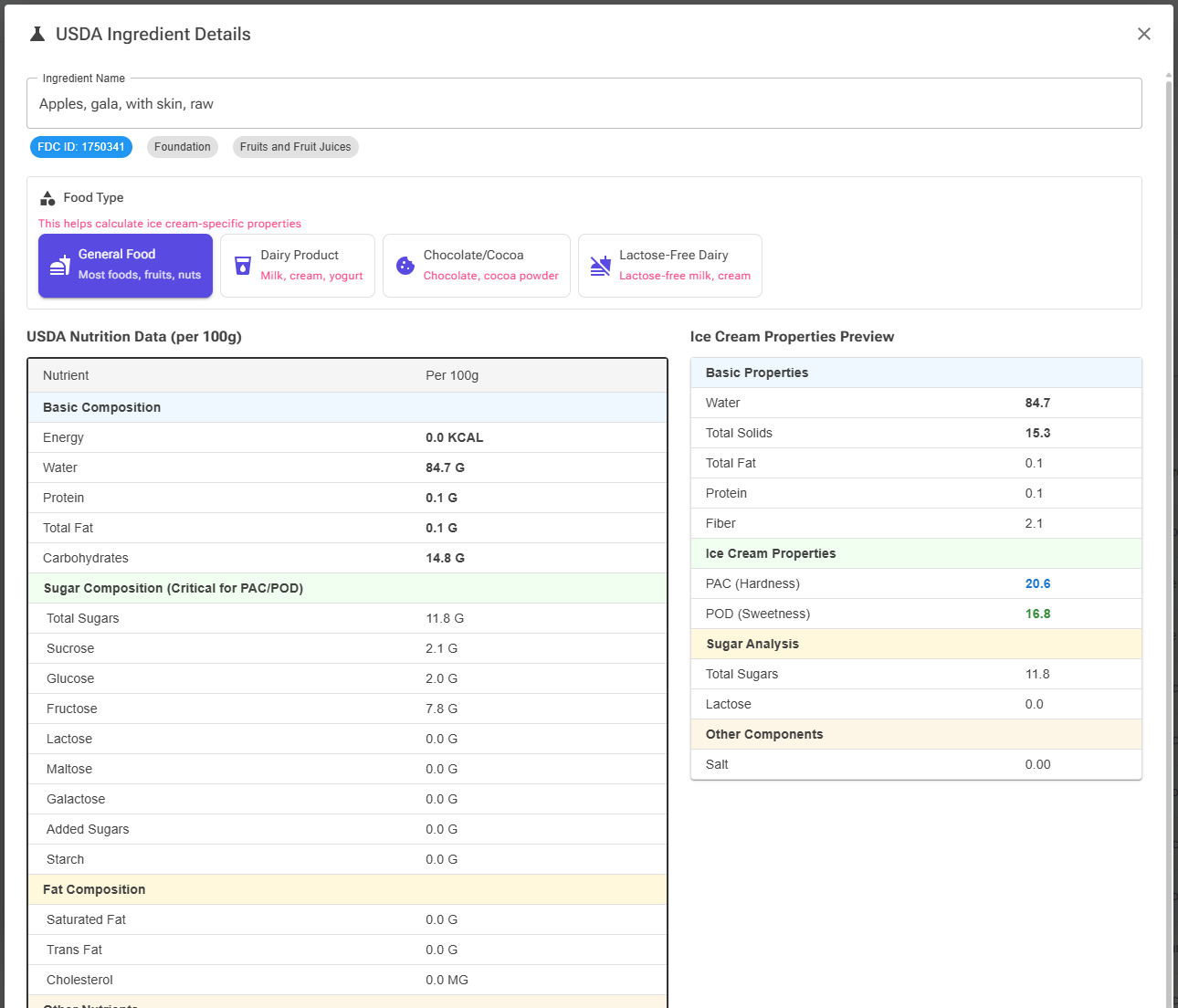
At the top of the dialog you can:
- Edit the ingredient name – Defaults to the USDA description but you can rename it to something shorter or more convenient (e.g. rename "Cream, heavy whipping" to simply "Heavy Cream")
- See a row of chips showing the FDC ID, the data type (Foundation, SR Legacy, etc.), the brand (if applicable), and the food category
Food Type Picker
This is the most important decision on the page. As explained in the introduction, the food type is how the Ice Cream Calculator bridges USDA nutrition data and ice cream-specific properties – without it, there's no way to know whether "fat" means milk fat, cocoa fat, or just generic fat, and no way to split "total sugars" into the individual sugars that determine PAC and POD.
There are four options, each shown as a clickable card:
General Food
Used for: Most foods – fruits, nuts, vegetables, grains, sugar, cocoa powder used as a flavoring (not cocoa solids), spices, etc.
What gets calculated: Basic nutritional properties; PAC/POD derived from total sugars (assumed to be sucrose if no breakdown is available).
Dairy Product
Used for: Milk, cream, yogurt, cheese, butter, milk powder, etc.
What gets calculated:
- All fat is treated as Milk Fat (butter fat)
- Natural sugars are treated as Lactose
- MSNF (Milk Solids Not Fat) is calculated
- PAC/POD uses the correct coefficients for lactose
Chocolate/Cocoa Product
Used for: Chocolate bars, cocoa powder used as a structural ingredient, chocolate chips, cocoa mass, etc.
What gets calculated:
- Fat is treated as Cocoa Fat (cocoa butter)
- Non-fat solids become Cocoa Solids
- Hardening Factor (HF) is calculated to account for chocolate's firming effect on ice cream texture
Lactose-Free Dairy
Used for: Lactose-free milk, cream, yogurt, etc. – dairy products treated with lactase enzyme.
What gets calculated:
- All fat is treated as Milk Fat
- Natural sugars are split 50/50 into glucose and galactose (the breakdown products of lactose)
- PAC/POD reflects the much higher sweetness and freezing-point depression of the converted sugars
- MSNF is calculated correctly
Auto-detection: The dialog makes an initial guess based on the food's category and name:
- Names or categories containing "dairy", "milk", "cream", "cheese", "yogurt", or "butter" → Dairy
- Names or categories containing "chocolate" or "cocoa" → Chocolate
- Everything else → General
Lactose-Free Dairy is never auto-detected – you'll always need to select it manually if that's what you want.
Important: Always verify the auto-detected type before adding to your library. The ice cream properties are calculated directly from this choice, so getting it wrong produces wrong PAC, POD, and MSNF values.

USDA Nutrition Data (Left Column)
The left column shows the nutrient data exactly as USDA provides it, per 100g, grouped into sections:
- Basic Composition – Energy, Water, Protein, Total Fat, Carbohydrates
- Sugar Composition – Total Sugars, Sucrose, Glucose, Fructose, Lactose, Maltose, Galactose, Added Sugars, Starch. This section is highlighted because it's critical for PAC/POD accuracy.
- Fat Details – Saturated Fat, Trans Fat, Cholesterol
- Other Nutrients – Fiber, Sodium, Alcohol, Vitamin D, Calcium, Iron, Potassium
Sugars that USDA didn't report are marked "Not available" rather than shown as zero. This matters: a missing value is not the same as a zero value, and the calculation engine handles them differently.
Sugar Data Warning
If USDA reports no sugar data but the carbohydrate total suggests sugars are present, a yellow warning appears in the sugar section:
"No sugar data reported but carbs suggest sugars may be present. PAC/POD may be inaccurate — consider adding sugar values manually after import."
When this happens, the app falls back on assigning all the reported total sugars based on the food type (e.g. treating them as lactose for Dairy, or sucrose for General). That's a reasonable guess for many foods, but for anything where sugar composition matters (e.g. fruit purees with mixed glucose/fructose/sucrose), you'll get better PAC/POD accuracy by editing the ingredient's sugar breakdown manually after import.
Ice Cream Properties Preview (Right Column)
The right column shows a live preview of the ice cream properties as they'll be saved to your library. This preview updates instantly when you change the food type, so you can see exactly what picking "Dairy" vs "General" does to your numbers.
The preview is grouped into sections:
- Basic Properties – Water, Total Solids, Total Fat, Protein, Fiber
- Ice Cream Properties – PAC (Hardness) and POD (Sweetness); plus MSNF and Milk Fat for dairy types; plus Cocoa Fat, Cocoa Solids, and Hardening Factor for chocolate
- Sugar Analysis – Total Sugars, Lactose, Polyols (if any)
- Other Components – Salt, Alcohol (only shown when non-zero)
Tip: If the PAC or POD values look off, the usual causes are (a) wrong food type selected, or (b) missing sugar breakdown in the USDA data. Check the warning area in the left column first, then try switching food types to see if the numbers make more sense.
Add to Library
The green "Add to Library" button in the footer creates the ingredient using the name you entered and the calculated properties shown in the right column. The ingredient is added to your personal ingredient library and the dialog closes, returning you to wherever you opened the dialog from (usually the Ingredient dialog or the ingredients list).
Clicking Cancel discards everything and returns to the Search Dialog so you can pick a different food.
Typical Workflows
Import a Basic Ingredient
- Open the USDA dialog
- Type the food name (e.g. "heavy cream")
- Start on the Foundation tab, then try SR Legacy if nothing matches
- Click the best result
- Verify the auto-detected food type (likely "Dairy" for cream)
- Review the Ice Cream Properties preview – PAC, POD, MSNF all look reasonable?
- Rename the ingredient if needed
- Click Add to Library
Import a Specific Branded Product
- Open the USDA dialog
- Type the product or brand name
- Switch to the Branded tab – the result count is shown in the tab label
- Optionally use the Brand filter to narrow down
- Click the product and verify it's the right pack size / variant (check the chips for brand info)
- Pick the right food type – branded products are often auto-detected as General even when they're dairy, so double-check
- Click Add to Library
Fast Import by FDC ID
- Copy the FDC ID from the USDA FoodData Central website or any reference
- Open the USDA dialog
- Check the FDC ID Lookup checkbox
- Paste the ID and press Enter
- The Detail Dialog opens directly – review and add to library
Handle a Food with Missing Sugar Data
- Search and pick your food as usual
- If the yellow sugar warning appears in the Detail Dialog, note it
- Import the ingredient anyway
- After import, open the ingredient and manually enter the sugar breakdown (sucrose, glucose, fructose, etc.) based on the best data you have – manufacturer spec sheet, supplier documentation, or published food composition tables
- The PAC/POD values will recalculate automatically
Tips and Best Practices
Pick the Right Source First
- For basic ingredients (milk, cream, sugar, eggs, cocoa powder, fruit), Foundation or SR Legacy give the cleanest, most complete data
- Use Branded only when you specifically need a commercial product – data quality varies
- Survey (FNDDS) is usually less useful for formulation – it's aimed at dietary intake analysis
Always Verify the Food Type
- Auto-detection catches the common cases but isn't perfect
- Food type directly affects PAC, POD, MSNF, and Hardening Factor calculations – the most important ice cream numbers
- If you're unsure, watch the Ice Cream Properties preview switch as you try different types
Rename for Your Library
- USDA names are long and technical (e.g. "Milk, whole, 3.25% milkfat, with added vitamin D")
- Rename to something short and meaningful for your recipes (e.g. "Whole Milk 3.25%")
- Consistent, short names make recipe display and formulas much easier
Review Before Saving
- The right-column preview is there precisely so you can catch problems before they land in your library
- If PAC or POD look implausible, pause and check the sugar data in the left column
- For complex ingredients (branded products, cookies, multi-ingredient mixes), consider importing only as a starting point and adjusting the values manually afterwards
Understand What's Calculated vs Guessed
- Calculated accurately: Water, Total Solids, Total Fat, Protein, Fiber – these come directly from USDA data
- Calculated well: PAC/POD when the individual sugar breakdown is present in USDA data
- Guessed: PAC/POD when only "Total Sugars" is reported – the app assigns the total to a single sugar type based on food type
- Guessed: MSNF, Milk Fat, Cocoa Fat, Cocoa Solids – derived from the food type classification, not directly reported by USDA
If accuracy matters for a particular ingredient, plan to verify and adjust the key values manually after import.
Summary
The USDA dialog is a fast path from "I need this ingredient" to a fully-calculated entry in your library:
- USDA provides the raw data – Comprehensive, government-verified, free
- Food Type bridges the gap – Turns generic nutrition data into ice cream-specific properties (PAC, POD, MSNF, Cocoa Fat/Solids, Hardening Factor) that nutrition labels never show
- Two-step flow – Search for the food, then review and import
- Four data sources – Foundation, SR Legacy, Branded, Survey – each with its own strengths
- Fast local search for Foundation and SR Legacy; live API for Branded and Survey
- FDC ID Lookup for when you already know exactly what you want
- Live ice cream properties preview – see the numbers before committing
- Warnings for incomplete data – the sugar warning helps you catch cases where PAC/POD will be a rough guess
Remember:
- Start with Foundation or SR Legacy for basic ingredients
- Always verify the food type – it drives the most important calculations
- Rename USDA entries to short, consistent names for your library
- Use the preview to sanity-check PAC/POD before saving
- For ingredients with missing sugar data, plan to fill in the breakdown manually after import
Next Steps
Explore related topics:
- Ingredient Dialog Guide – Edit and fine-tune imported ingredients
- PAC and POD Explained – Understand what these numbers mean and how they're calculated
- Nutrition Label Import – The alternative import method when USDA doesn't have the food you need
Happy ice cream making! 🍦