By Chiara Ghiron, a food-loving chemist by training, vegan ice cream teacher and founder of The Craftsy Cat. This guest article is published here with her permission.
Four different jobs in one frozen structure.
What Is a Fiber?
The definition of fiber is nutritional rather than structural. It tells us which compounds our digestive system cannot break down and absorb in the small intestine; it does not tell us whether an ingredient will make an ice-cream mix thick. In the European Union, the definition includes specified carbohydrate polymers, and isolated or synthetic polymers have to meet the relevant criteria too. Most fibers are carbohydrate chains, but their structure makes them behave very differently.
Starch and cellulose are both made of glucose units. The difference is how those units are joined, and that small change matters a great deal to our digestive enzymes. Amylase can break most starch down into glucose, which our body absorbs and uses for energy. Cellulose is also made of glucose, but its structure is inaccessible to amylase. We can eat pasta, but not paper!
Some starches are harder to digest. Green bananas contain more resistant starch than ripe bananas, and when we cook potatoes and let them cool, some of the starch becomes more crystalline and less accessible to digestion. We call these fractions resistant starch. Dextrins can also be modified to make them less digestible and useful as bulking ingredients. But “dextrin” on its own does not mean “resistant” or “fiber”; the ingredient specification matters.
Gut bacteria can ferment many fibers, though not all of them to the same extent. This fermentation produces short-chain fatty acids and gases; some of the products are absorbed and used by the body. That is why fiber is not counted as zero calories on an EU nutrition label: the prescribed energy factor is 2 kcal per gram. Fermentation can also cause discomfort for some people. The effect depends on the fiber, the amount eaten and the person, so there is no single threshold that applies to every fiber or every serving of ice cream.
Added, isolated fiber may not provide all the benefits of fiber found in whole grains or vegetables. But when the ingredient qualifies as dietary fiber, it still contributes to our total fiber intake and can help us move towards the recommended amount, around 30 grams a day for adults in many guidelines.
A Frozen Dessert Needs More Than a Thick Mix
Most soluble fibers are hydrophilic: they attract and hold water. But “soluble” is not enough to predict what one will do in a mix. Chain length, branching, hydration, concentration, shear, temperature, pH, salts and the other ingredients all play a part. Some fibers add solids with little thickening; others make the serum viscous, help stabilize oil droplets or form a network. Those jobs can overlap, but the fibers are not interchangeable.
Ice cream is made of several phases working together. Ice crystals and air cells sit in the concentrated liquid serum, and partially coalesced fat helps support the air. In dairy ice cream, proteins and fat take on several jobs at once. In a vegan mix, we need to build those functions with ingredients that can behave quite differently. Fibers can slow water movement, add body and help stabilize an emulsion. They do not, by themselves, replace proteins at interfaces or create the fat network that develops during churning.
As the mix freezes, water leaves the serum and becomes ice. Sugars, salts and other soluble solids are left behind in a smaller amount of liquid, so that serum becomes more concentrated and more viscous. A suitable stabilizer can slow water movement and help limit ice-crystal growth during storage. But there is a balance: if the mix gets too viscous, it can be harder to process and harder to whip air into. A smooth ice cream is not simply a thick mix; ice, air, fat, particles and serum all have to work together.
In this article, we’ll look at how some common fibers behave in ice cream. This is by no means an exhaustive review, but I hope it encourages further experimentation and gives a sense of the complexity of the field.
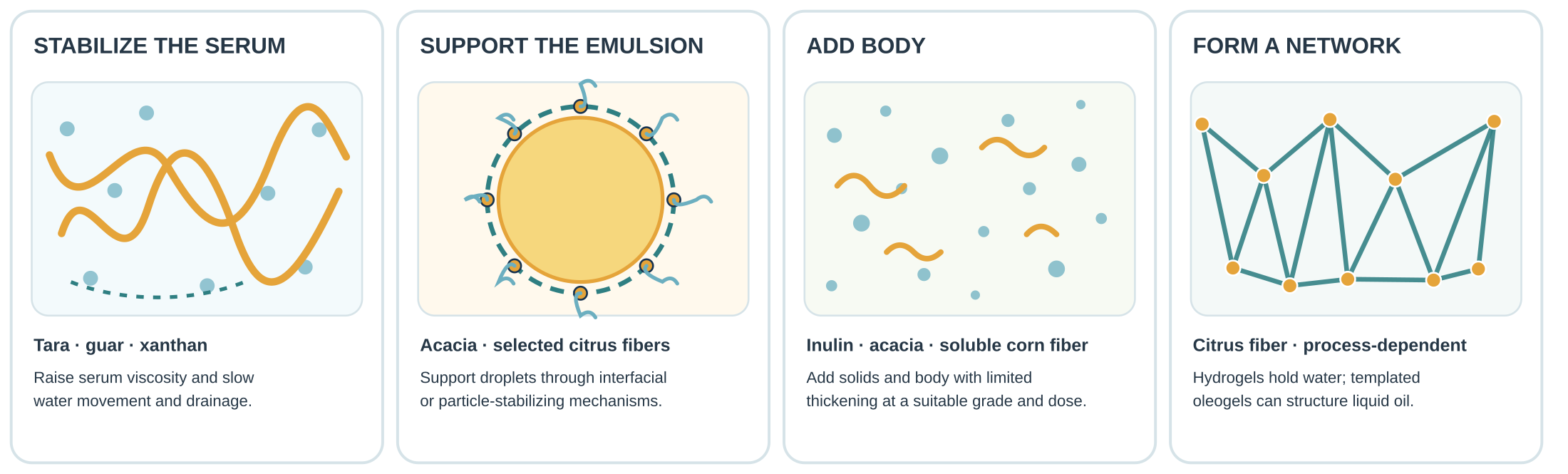
Figure 1. Soluble fibers can stabilize the serum, support oil-droplet stability, add body with limited thickening, or form water- and oil-structuring networks. These are functional roles rather than fixed ingredient classes; performance depends on grade, dose and process.
1. Fibers Used as Stabilizers
Tara, guar and locust bean gum are galactomannans: long carbohydrate chains that hydrate in water and thicken the continuous phase. Locust bean gum needs heating to hydrate fully. Guar hydrates more readily, and even a small amount can give a lot of thickening and elasticity. Too much, though, and the mix can turn stringy or gummy. Tara sits somewhere between guar and locust bean gum in its behavior. Xanthan, made by fermentation, is effective at very low levels. It is shear-thinning, which means the mix flows more easily while it is being pumped or churned than it does when left to rest. Xanthan also works across a broad range of pH and temperature, and it holds up in recipes containing alcohol.
These gums do most of their work in the serum. They slow water movement and drainage, and can delay ice-crystal recrystallization during storage. They do not stop the mix freezing, and they do not stop ice crystal formation altogether. They are useful when the plant base is very fluid or when the ice cream needs to stay stable in storage. Gums can also work better together: locust bean gum with guar or xanthan, or tara with a little xanthan, can give a different balance from either gum on its own. The best blend depends on the proteins, fats and other solids in the mix, as well as on heating and ageing.
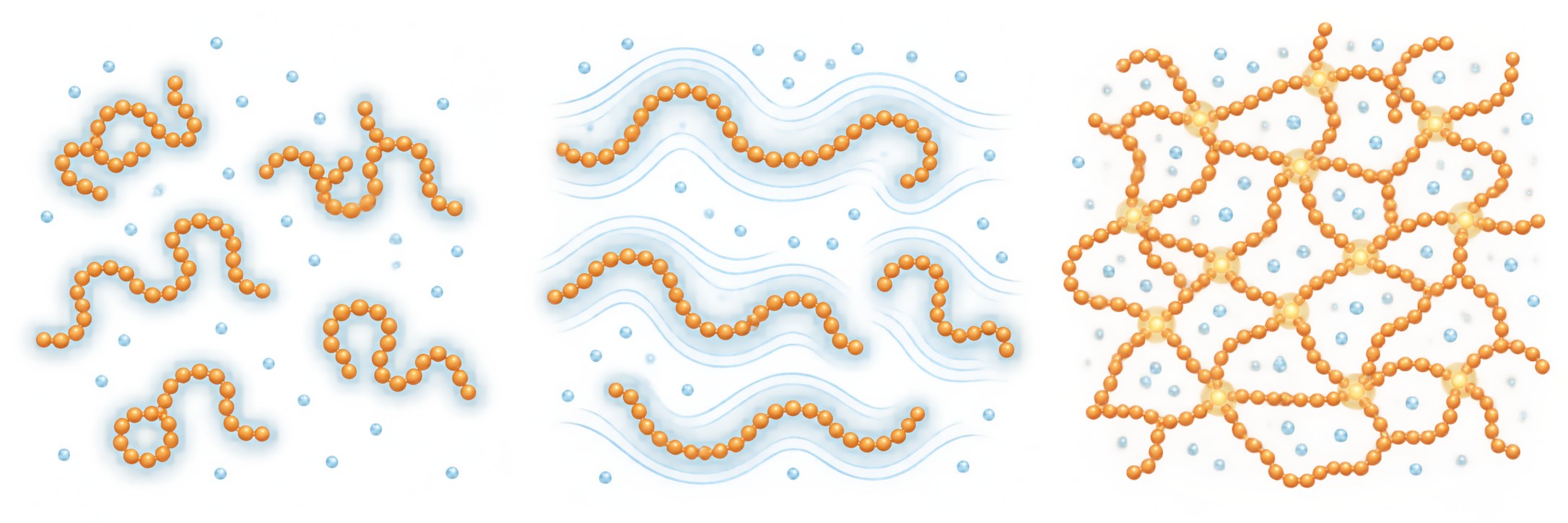
Figure 2. Hydrated chains may remain dispersed (left), increase hydrodynamic drag while still separate (center), or overlap into a connected network at higher concentration (right). The transition depends on the polymer, concentration, hydration and processing.
It is tempting to say that a gum “binds water,” but that can give the wrong picture. The water is still there. What changes is how easily the serum can move and drain. We want enough structure to protect the ice cream, but we still need the mix to flow through the machine and take in air.
2. Fibers That Add Body with Limited Thickening
Sometimes a mix has enough viscosity but still feels thin or watery. It may need more solids and a fuller mouthfeel, rather than more gum. Inulin, acacia and soluble corn fiber can help add that body, though they do not behave in the same way. They add material to the serum and can help with water management without thickening as strongly as a gum at the same dose. “Limited thickening” is relative, of course: the fiber grade, amount and process all matter.
Inulin is a family of fructans, not one uniform ingredient. Its chain length and structure affect how soluble it is and what it does to the texture. Shorter-chain inulin, branched inulin and fructooligosaccharides tend to stay more soluble. Longer-chain inulin can increase viscosity and, in the right conditions, form a particulate or weak-gel structure that gives a more fat-like perception. In one ice-cream study, the longer-chain inulin increased mix viscosity and made a harder product than the shorter-chain fractions. So, we cannot say that inulin always adds solids without thickening; the grade matters.
Long-chain inulin can make an ice cream feel creamy, but it does not lubricate the same way as fat, stabilize oil droplets at an interface or form the fat network that supports air. Inulin and fructooligosaccharides can also cause gut discomfort in some people. While ice cream guidelines often indicate a 2% or 4% limit, tolerance depends on the fiber, how much is eaten in one serving, whether the fiber-containing food is eaten separately or during a full meal, and the individual consumer. Published tolerance studies do not give one cut-off for all fibers.
Acacia is useful here too: it can add solids and body without making the mix very viscous, and it can support an emulsion as well. Acacia fiber is also reported to be better tolerated than inulin.
Soluble corn fiber, sometimes sold as glucose fiber, is often made from resistant dextrins. It is not corn starch, which thickens and gelatinizes differently. It is not the same as maltodextrin or glucose-syrup solids either; those are generally more digestible and affect sweetness and freezing point differently. The name “dextrin” alone does not tell us what the ingredient will do, so check the supplier’s specification.
Polydextrose is another bulking ingredient with little sweetness. It is a manufactured glucose polymer that resists digestion in the small intestine because of its different three-dimensional structure. For the same reason, gut bacteria find polydextrose more difficult to process, but they can still ferment some of it. Some people tolerate polydextrose better than rapidly fermented fibers; that does not mean it can never cause symptoms, especially at higher amounts.
3. Fibers That Help Stabilize Emulsions
Acacia fiber, also called gum arabic, is useful when we want to support oil droplets without making the whole mix very thick. It contains arabinogalactan-protein fractions: the protein-rich parts can attach to the oil-water interface, and the carbohydrate chains help keep droplets from coming together. Studies of Acacia senegal gum show that the amount and type of these fractions affect droplet size and emulsion stability. Acacia from different sources, or processed in different ways, may therefore perform differently.
Acacia does not thicken the mix as quickly as a small dose of guar or xanthan, so it can be helpful when we want emulsion support and extra solids without a big rise in viscosity. But stabilizing an emulsion is not quite the same job as a low-molecular-weight ice-cream emulsifier such as lecithin or mono- and diglycerides. During churning, proteins and fat still have to rearrange at the air and fat interfaces. Acacia may help stabilize the emulsion before freezing, but we should not expect it to build the partially coalesced fat network on its own.
Citrus fiber is less predictable because it is a mixture of materials. One product may contain more pectin, another more cellulose, hemicellulose or fine cell-wall particles. Residual protein and emulsifying behavior can vary with processing too. Some citrus fibers help stabilize droplets at the interface or as fine particles; others mainly hold water and increase viscosity. Ice-cream studies have found better melting resistance, but citrus fiber can also thicken the mix quite a lot. It does not necessarily do every job of a conventional emulsifier.
Oat beta-glucan and soluble pea-fiber fractions may help an emulsion too, often indirectly: they can thicken the water phase or interact with proteins. That does not mean they necessarily attach strongly to the oil-water interface. As always, the specific ingredient matters. Looking at the specification, particle size and hydration, and seeing how it behaves at the dose and churning conditions used is important.
4. Citrus Fiber in Hydrogels and Oleogels
Some fibers can do more than thicken a liquid: at the right concentration, with enough hydration and the right processing, they can form a connected network. If that network holds water, we call it a hydrogel. Citrus fiber can swell and hold water because of its pectin-rich and particulate structure. Under suitable conditions, it can form a network that immobilizes part of the water phase. Whether a particular commercial fiber will do this usefully depends on its composition, particle size, dose, pH, salts, temperature and shear history.
An oleogel is a different system. Here, a network immobilizes liquid oil and gives it a semi-solid structure. One way to make a fiber-based oleogel is emulsion templating: first, a fiber-rich water phase helps organize an oil emulsion; then processing creates the network that traps the oil. Citrus fiber has been studied as the only structuring agent in this kind of oleogel. So it is not simply a matter of stirring dry fiber into oil. Hydration, droplet structure and processing all help build the network. The study shows a way of structuring oil; it does not, by itself, give us a finished ice-cream recipe.
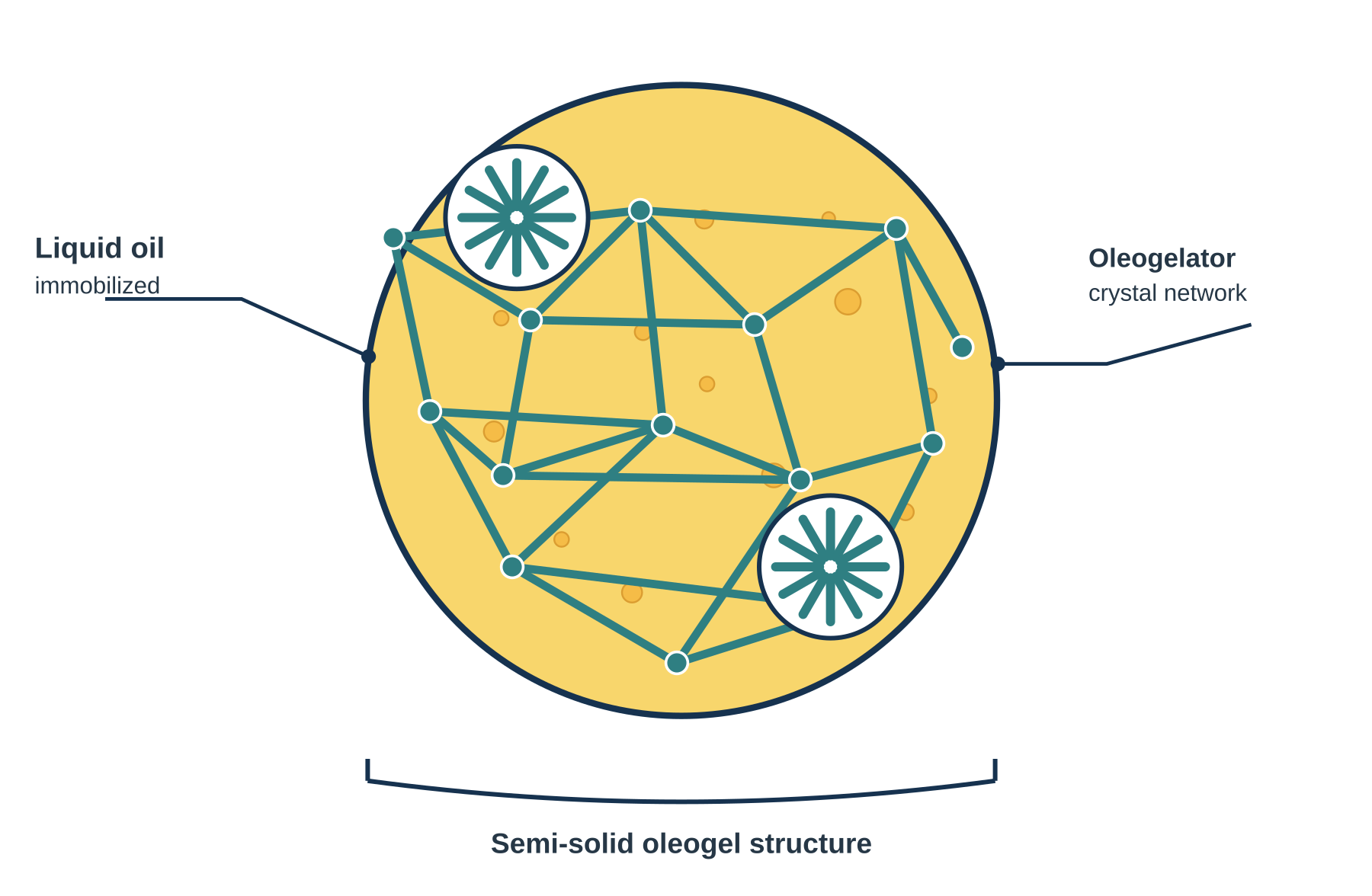
Figure 3. Generic oleogel schematic: a structuring network immobilizes liquid oil. Fiber-based oleogels may use different microstructures and commonly require emulsion templating; this drawing is not a literal depiction of every citrus-fiber oleogel.
Why might this interest us in vegan ice cream? A hydrogel can help structure the water phase; an oleogel can change how the fat phase behaves and may help structure an unsaturated oil. These are useful ideas, especially given current nutritional recommendations on saturated fat intake, but neither automatically replaces protein at the interface or the fat network that supports air cells. We still have to make sure the mix churns well, melts cleanly and feels pleasant in the mouth.
Choosing a Fiber by Function
I find it helpful to start with the problem in the mix. If the serum is too mobile and ice crystals are growing during storage, try a stabilizing gum such as tara, guar or xanthan. If you need emulsion support but do not want a big increase in viscosity, look at acacia; with citrus fiber, check the specific product first. If the mix has enough viscosity but needs more body, a suitable grade of inulin, acacia or soluble corn fiber may help. And if you want a water or oil network, treat it as a hydrogel or oleogel system: a simple thickener will not necessarily give you one.
Give the fiber time to hydrate and age before judging the mix. Then look at how it flows, whether it separates, how it incorporates air, and what happens at extraction, hardening, meltdown and storage. Taste it too! A fiber that slows drainage or melting can still feel pasty, elastic or coating if there is too much of it. The best choice is the one that solves the problem without getting in the way of the rest of the ice-cream structure.
Fibers in Ice Cream Calculator
This section was added by Ice Cream Calculator.
- Balancing: in the Smart Balance dialog, give an added bulking fiber such as inulin the Fib class chip, and a gum such as guar, tara, locust bean gum or xanthan the Stab chip. Each chip keeps the ingredient within a sensible dose range while the recipe is balanced. See Balancing and Stabilizers & Emulsifiers.
- Vegan charts: fibers count towards TSNFS (total solids not fat or sugar), the property the vegan charts use in place of milk solids. See Introduction to Vegan Ice Cream.
- Energy: the calculator counts fiber at 2 kcal per gram, the EU factor mentioned above. Enter the fiber content of your ingredients so that the energy on your nutrition labels comes out right.
Selected References
- Ghiron C. Corso Gelato 2026: online course slides on stabilizers, inulin, acacia and plant-based ice cream. www.thecraftsycat.com
- Goff HD, Hartel RW, Rankin SA. Ice Cream. 8th ed. Springer Nature; 2025.
- European Parliament and Council. Regulation (EU) No 1169/2011 on food information to consumers, including Annex XIV.
- Aphibanthammakit C, Barbar R, Nigen M, Sanchez C, Chalier P. Emulsifying properties of Acacia senegal gum: Impact of high molar mass protein-rich AGPs. Food Chemistry: X. 2020;6:100090. doi:10.1016/j.fochx.2020.100090.
- Dervisoglu M, Yazici F. The effect of citrus fibre on the physical, chemical and sensory properties of ice cream. Food Science and Technology International. 2006;12(2):159-164. doi:10.1177/1082013206064005.
- Loffredi E, Moriano ME, Masseroni L, Alamprese C. Effects of different emulsifier substitutes on artisanal ice cream quality. LWT. 2021;137:110499. doi:10.1016/j.lwt.2020.110499.
- Prebiotic ice cream without additives: The influence of degree of inulin polymerization on product manufacturing. Food Research International. 2025;221(Part 2):117279. doi:10.1016/j.foodres.2025.117279.
- Jiang H, Qi J. Structuring oleogels with citrus fiber as the sole gelling agent: Precise modulation of the network structure via enzymatic method. Food Hydrocolloids. 2026. doi:10.1016/j.foodhyd.2025.112309.
- Mysonhimer AR, Holscher HD. Gastrointestinal effects and tolerance of nondigestible carbohydrate consumption. Advances in Nutrition. 2022;13(6):2237-2276. doi:10.1093/advances/nmac094.