Concepts & Properties
Table of Contents
- The Ingredient Library
- Creating & Editing Ingredients
- Basic Nutritional Properties
- Ice Cream Science: PAC, POD & HF
- Dairy-Specific Properties
- Chocolate-Specific Properties
- Validation & Quality Checks
1. The Ingredient Library
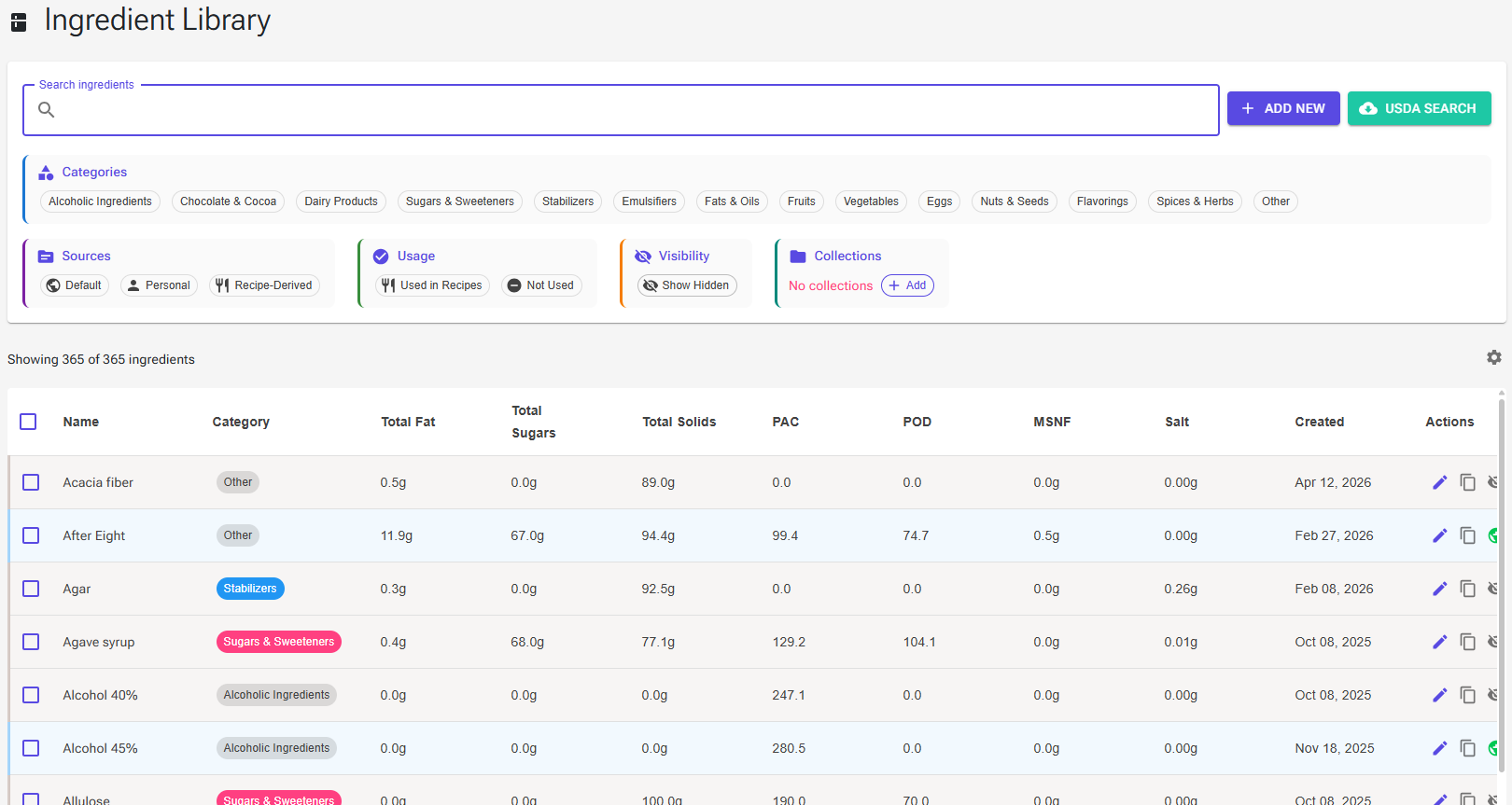
The Ingredient Library is your central hub for browsing, searching, and managing all ingredients available for your ice cream recipes. The library contains both shared/public ingredients (available to all users) and your personal ingredients (ingredients you've created or customized).
1.1 Understanding the Ingredient Table
The ingredient table displays comprehensive information about each ingredient:

Always Visible Columns:
- Checkbox — Select ingredients for bulk operations
- Name — The ingredient name (click to view/edit details)
- Category — Color-coded category chip (Dairy, Sugar, Fat, Fruit, Chocolate, Stabilizer, etc.)
- Actions — Edit, copy, hide, delete buttons
Customizable Columns:
You can show/hide additional data columns by clicking the Settings (gear) icon next to the results count (desktop only). The system offers over 30 columns organized into categories:
Basic Nutritional Data: Total Fat, Protein, Total Sugars, Water, Total Solids, Carbohydrates (US & EU), Fiber
Ice Cream Properties: PAC (freezing point depression), POD (relative sweetness), HF (hardening factor), MSNF (milk solids not fat), Lactose
Detailed Nutrition: Saturated Fat, Unsaturated Fat, Trans Fat, Cocoa Fat, Milk Fat, Other Fat, Sugar (excluding lactose), Added Sugars, Polyols, Sodium, Cholesterol, Calcium, Iron, Potassium, Vitamin D, Stabilizers, Emulsifiers
Click any column name chip to toggle it on/off (selected columns show in blue). Use the Reset to Default button to restore the standard columns (Total Fat, Total Sugars, Total Solids, PAC, POD).
1.2 Search & Filtering

The search and filter system helps you quickly find the right ingredients. All filters are presented as clickable chips, and you can combine multiple filters at once.
Search Bar
At the top of the filter card you'll find the search bar along with two buttons:
- Add New — Creates a blank ingredient and opens the editor
- USDA Search — Search over 400,000 ingredients from the USDA FoodData Central database and import directly
Type in the search field to filter by ingredient name or description. Search is real-time with a short delay for performance, and it matches both ingredient names and the info/description field (case-insensitive).
Filter by Category
Use the Category chips to show only ingredients from specific categories. Click any chip to toggle it — you can select multiple categories at once. Selected chips are highlighted in blue.
Available categories: Dairy, Sugar, Fat, Fruit, Chocolate, Stabilizer, Emulsifier, Alcohol, Nut, Egg, and Other.
Filter by Source
The Source filter (authenticated users only) helps you distinguish between different types of ingredients. Three source chips are available:
- Default — Shared/public ingredients available to everyone (shown with a public icon)
- Personal — Ingredients you created from scratch or customized from shared ingredients (shown with a person icon)
- Recipe-Derived — Ingredients created from your recipes (shown with a restaurant icon)
Filter by Usage
The Usage filter lets you find ingredients based on whether they appear in any of your recipes:
- Used in Recipes — Show only ingredients that appear in at least one recipe
- Not Used — Show only ingredients not used in any recipe
This is helpful for cleaning up your ingredient library — find unused ingredients you may want to hide or delete.
Visibility Toggle
The Visibility section has a single Show Hidden chip. Click it to reveal ingredients you have previously hidden. Hidden ingredients are not deleted — they are simply removed from your default view. This keeps your ingredient library clean without losing any data.
Collections Filter
Collections let you organize ingredients into custom groups (e.g., "Base Ingredients", "Summer Flavors", "Supplier A").

- Click a collection chip to filter the list to only ingredients in that collection
- Each chip shows the number of ingredients it contains
- Click the Edit (pencil) icon to enter management mode where you can rename or delete collections
- Click Add to create a new collection
- You can add ingredients to collections using the bulk action bar (see below)
Understanding Source Types
Default (Shared) Ingredients:
- Available to all users
- Read-only — you cannot directly modify them
- Shown with a brown/grey background and public icon
- When you edit a shared ingredient, you create a personal copy
Personal Ingredients:
- Created by you from scratch, or created as copies of shared ingredients
- Shown with a blue background and person icon
- Only visible to you (not shared with other users)
- Full control — you can edit or delete these
Recipe-Derived Ingredients:
- Created from your recipes (turning a recipe into an ingredient)
- Shows a restaurant icon before the name
- Can be updated from the source recipe when it changes
- Useful for creating components (bases, variegates, inclusions)
Results Count & Clearing Filters
Below the filter card, you'll see a results summary like "Showing 45 of 237 ingredients". When filters are active, a Clear Filters button appears to reset everything.
1.3 Ingredient Actions

Each ingredient row has action buttons on the right side. The available actions depend on the ingredient type.
For All Users (Authenticated):
Edit (pencil icon)
- Opens the ingredient editor
- For shared ingredients: opens the editor with a "Will Create Personal Copy" indicator — your changes will be saved as a new personal ingredient
- For personal ingredients: edits your existing ingredient directly
Copy (copy icon)
- Creates a new personal ingredient based on the selected one
- Automatically generates a unique name (e.g., "Whole Milk (Copy)", "Whole Milk (Copy 2)")
- Useful for creating variations of existing ingredients
Hide (eye-off icon) — for shared ingredients
- Hides the ingredient from your default library view
- The ingredient is not deleted — use the Show Hidden visibility filter to see it again
- Useful for decluttering your library without losing data
Unhide (eye icon) — only visible on hidden ingredients
- Restores a hidden ingredient to your default view
- Only appears when viewing hidden ingredients via the Visibility filter
For Personal Ingredients Only:
Delete (trash icon)
- Permanently deletes your personal ingredient
- Shows warning if ingredient is used in recipes or has stock/production records
- Requires confirmation before deletion
Bulk Operations
You can select multiple ingredients and perform actions on them all at once:

- Use the checkbox next to each ingredient to select it, or use the Select All checkbox in the table header to select all visible ingredients
- A bulk action bar appears at the top showing how many ingredients are selected
- Available bulk actions:
- Collections — Add or remove selected ingredients from collections
- Report — Generate a report for the selected ingredients
- Hide — Hide all selected ingredients from your default view
- Unhide — Restore all selected hidden ingredients
- Delete — Delete all selected personal ingredients (with confirmation)
1.4 Visual Indicators
The ingredient table uses color coding and icons to help you quickly identify different types of ingredients:
Row Colors:
- Brown/Grey background with left border — Default (shared) ingredients
- Blue background with left border — Personal ingredients
Icons:
- Restaurant icon — Recipe-derived ingredient (appears before the name)
- Public icon — Shared/default ingredient
- Person icon — Personal ingredient
- Eye-off icon — Hidden ingredient (shown when viewing hidden ingredients)
Chips & Badges:
- Category chip — Color-coded by category (blue for Dairy, purple for Sugar, etc.)
- "Recipe-Derived" chip — Purple, shown for ingredients created from recipes
- "Hidden" chip — Orange outline, shown on ingredients you have hidden from your default view
- Collection chips — Small blue chips below the name showing which collections an ingredient belongs to (up to 3 shown, with "+X" if more)
1.5 Guest Users vs Authenticated Users
As a Guest (Not Logged In):
- Can browse all shared/public ingredients
- Can search and filter by category
- Can view ingredient details
- Cannot edit, create, or delete ingredients
- Cannot filter by source, usage, visibility, or collections
- See a notice encouraging you to sign up to add custom ingredients
As an Authenticated User:
- Everything guests can do, plus:
- Create new ingredients
- Edit any ingredient (creates a personal copy for shared ones)
- Delete your personal ingredients
- Copy ingredients
- Hide/unhide shared ingredients
- Use all filter types (source, usage, visibility, collections)
- Organize ingredients into collections
- Perform bulk operations on selected ingredients
2. Creating & Editing Ingredients
2.1 Creating a New Ingredient
There are several ways to create ingredients:
Method 1: Add New (Manual Creation)
- From the Ingredients page, click the Add New button (top of the filter card)
- This creates a blank ingredient named "New Ingredient"
- Fill in all the properties manually
- Best for: Simple ingredients or when you know all the values
Method 2: USDA Database Import
- Click Add New to create a blank ingredient
- On the Edit page, click the USDA Database button
- Search for your ingredient in the USDA database
- Import the nutritional data automatically
- Best for: Standard foods with official nutrition data
You can also use the USDA Search button directly from the Ingredients page toolbar to search the USDA database and import an ingredient without creating a blank one first.
Method 3: Nutrition Label Import
- Click Add New
- Click the Nutrition Label button
- Enter data from a product's nutrition label
- The system estimates ice cream properties
- Best for: Commercial products with nutrition labels
Method 4: AI Assistant
- Click Add New
- Click the AI Assistant button
- Describe the ingredient to AI in natural language
- AI estimates all properties including PAC/POD
- Best for: Quick estimates or unusual ingredients
Method 5: From Recipe
- Click Add New
- Click the From Recipe button (only available for personal ingredients)
- Select one of your existing recipes
- The recipe's nutritional values become the ingredient
- Best for: Using bases, variegates, or sub-recipes as ingredients
Method 6: Copy Existing Ingredient
- Find a similar ingredient in the library
- Click the Copy button
- Modify the copied ingredient
- Best for: Creating variations (e.g., different fat % milk)
2.2 The Edit Ingredient Page
The Edit Ingredient page has two main areas: the header section with basic info and import actions, and the Properties Editor below it with a tabbed interface for all ingredient data.
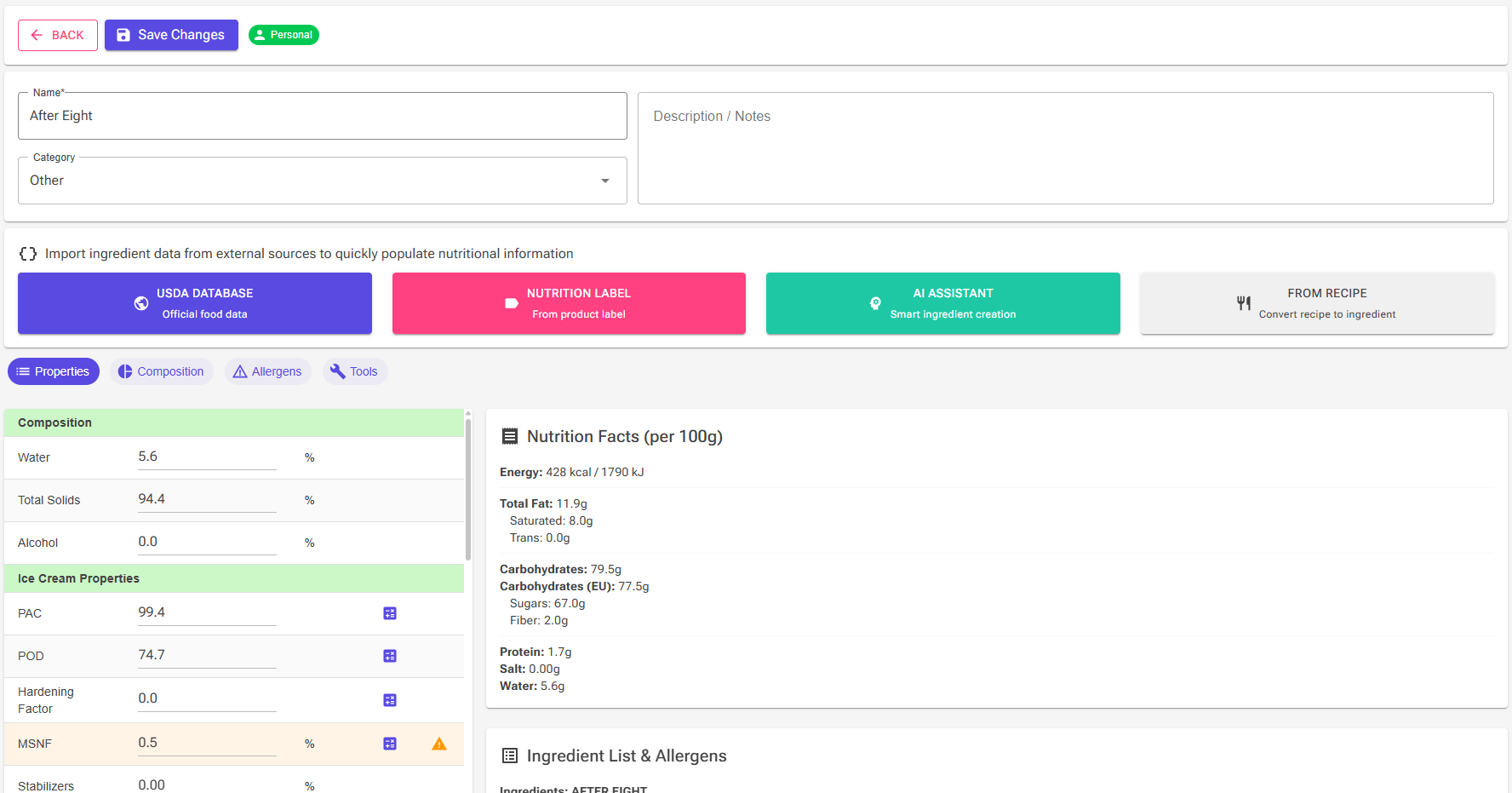
Header Section
- Back button — Returns to the ingredients library
- Save button — Saves changes (text adapts to validation status)
- Source chips — Shows the ingredient type (Default, Personal, Recipe-Derived)
- "Will Create Personal Copy" chip — Appears when editing a shared ingredient to indicate that saving will create a new personal ingredient rather than modifying the shared one
Basic Information Card:
- Name — Required field for ingredient name (auto-focused and selected for new ingredients). For recipe-derived ingredients, the name is synced from the source recipe and cannot be changed.
- Category — Dropdown to select category (Dairy, Sugar, Fat, Fruit, Chocolate, Stabilizer, Emulsifier, Alcohol, Nut, Egg, Other)
- Description/Notes — Multi-line text field for additional info
Import Actions Card:
Four large buttons for importing ingredient data (not shown for recipe-derived ingredients):
- USDA Database — Import from official USDA FoodData Central database
- Nutrition Label — Enter values from a product's nutrition label
- AI Assistant — Smart ingredient creation using AI
- From Recipe — Convert one of your recipes to an ingredient (personal ingredients only)
Recipe Source Card (Recipe-Derived Ingredients Only):

This card appears only for recipe-derived ingredients and shows:
- Which recipe this ingredient is linked to
- Edit Recipe button — Opens the source recipe for editing
- Unlink button — Removes the recipe connection (the ingredient becomes a regular personal ingredient you can edit manually, keeping its current values)
- A warning alert if the source recipe has been deleted or cannot be found
The Properties Editor (Tabbed Interface)
Below the header cards, the Properties Editor uses a tabbed interface with four tabs, selectable via chip buttons:
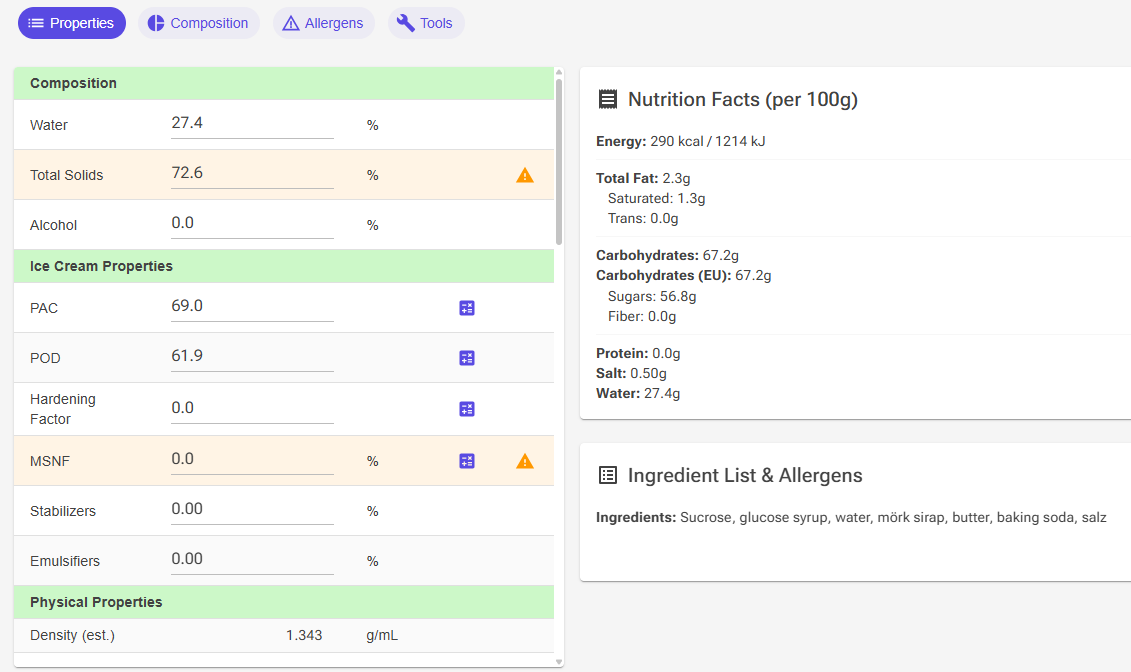
Tab 1: Properties
The Properties tab shows a compact, scrollable table with all ingredient values side by side with a Nutrition Facts summary card. The table is organized into clearly labeled sections with green header rows:
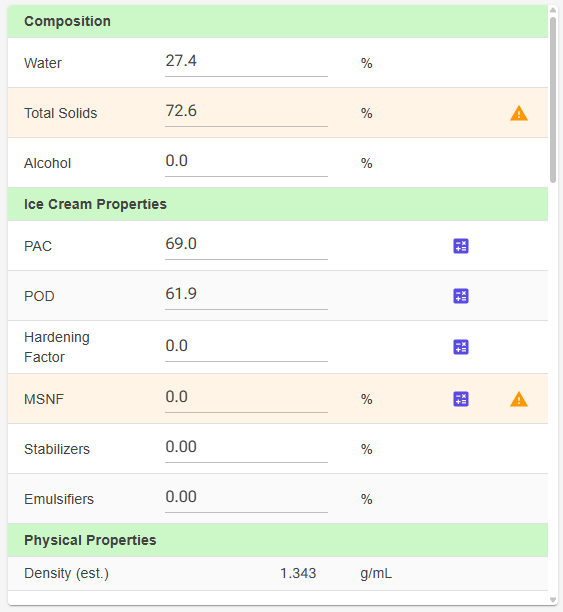
- Composition — Water, Total Solids, Alcohol (these three always sum to 100%)
- Ice Cream Properties — PAC, POD, Hardening Factor (each with a Calculate button), MSNF (with calculator), Stabilizers, Emulsifiers
- Physical Properties — Density (estimated, read-only) and Displacement (mL per 100g, with a bulkiness slider dialog for inclusions)
- Fats — Total Fat, Milk Fat, Cocoa Fat, Saturated Fat, Trans Fat
- Sugars — Total Sugars, Lactose, Added Sugars, Polyols
- Solids — Protein, Carbohydrates, Fiber, Other Solids, Cocoa Solids
- Nutrition — Salt, Sodium, Cholesterol, Vitamin D, Calcium, Iron, Potassium
- Amount Limits — Min Amount and Max Amount (percentage constraints for balancing)
- Custom Properties — Up to 10 user-defined fields (only shown if you have configured custom property names in your profile settings). These let you track any additional data such as supplier codes, cost per kg, or custom notes.
Inline Validation: Fields with data issues show a small warning, error, or info icon on the right side of the row. Click the icon to open a popover with the specific issue and, where applicable, quick-fix buttons (e.g., "Set to Total Fat", "Calc Sodium", "Swap values"). Row backgrounds also change color to highlight issues — for example, a row turns red-tinted if it has an error.
Nutrition Facts Card: Displayed alongside the properties table, this read-only card shows calculated nutrition label values per 100g — Energy (kcal/kJ), Total Fat, Saturated/Trans, Carbohydrates (US and EU), Sugars, Fiber, Protein, Salt, and Water.
Ingredient List & Allergens Preview: If you have set up sub-ingredients or allergen information for this ingredient, a second card appears below the Nutrition Facts card showing a formatted preview of the ingredient list (with allergens in BOLD UPPERCASE), grouped sub-ingredients, and allergen warnings — matching how they'll appear on reports and labels. An Edit button links to the full Sub-Ingredients & Allergens editing page.
Tab 2: Composition
The Composition tab provides a visual overview of how the ingredient is composed:
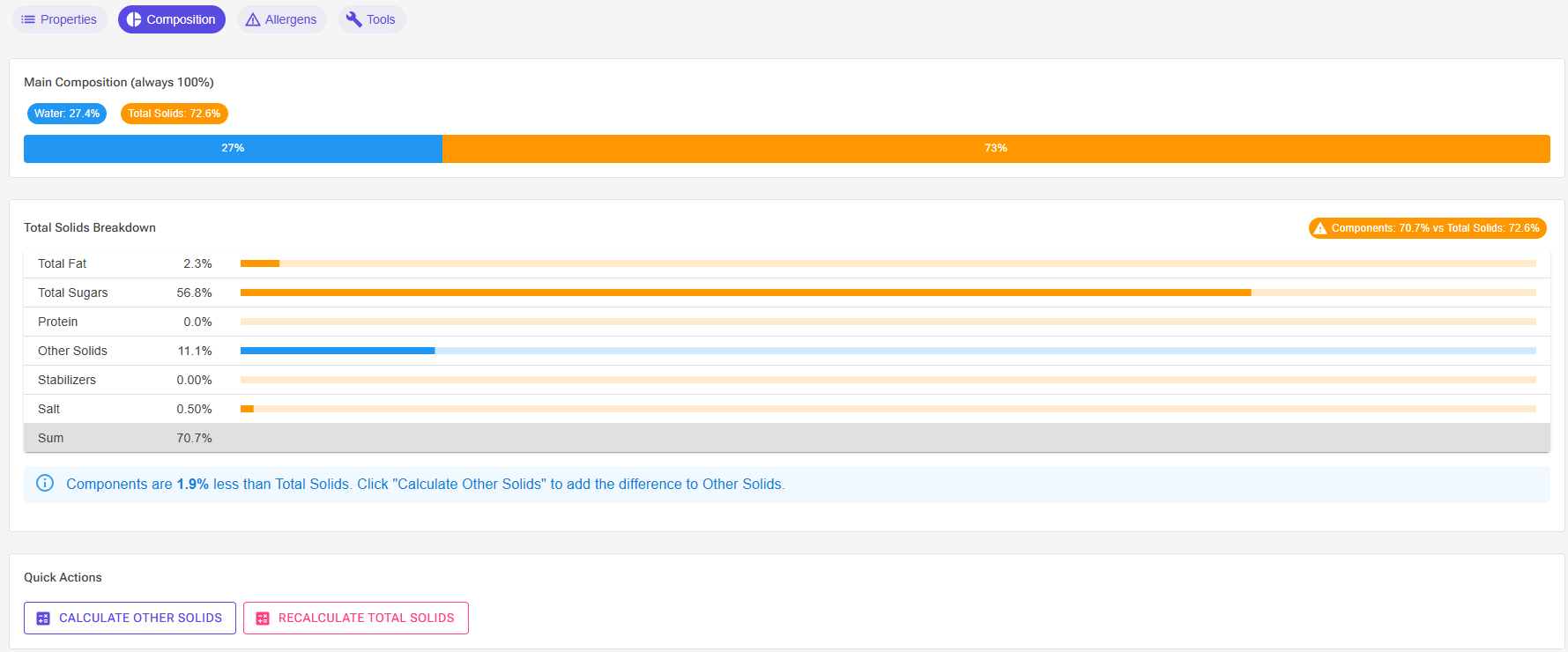
- Main Composition Bar — A stacked horizontal bar showing Water (blue), Total Solids (amber), and Alcohol (purple) as proportional segments that always sum to 100%
- Total Solids Breakdown — A table showing how Total Solids is composed of Total Fat, Total Sugars, Protein, Other Solids and Salt, each with a progress bar. A chip at the top shows whether the components are balanced ("Balanced ✓") or if there's a mismatch.
- Quick Actions — Two buttons: "Calculate Other Solids" (adjusts Other Solids to balance the breakdown) and "Recalculate Total Solids" (recalculates Total Solids from components)
Tab 3: Allergens
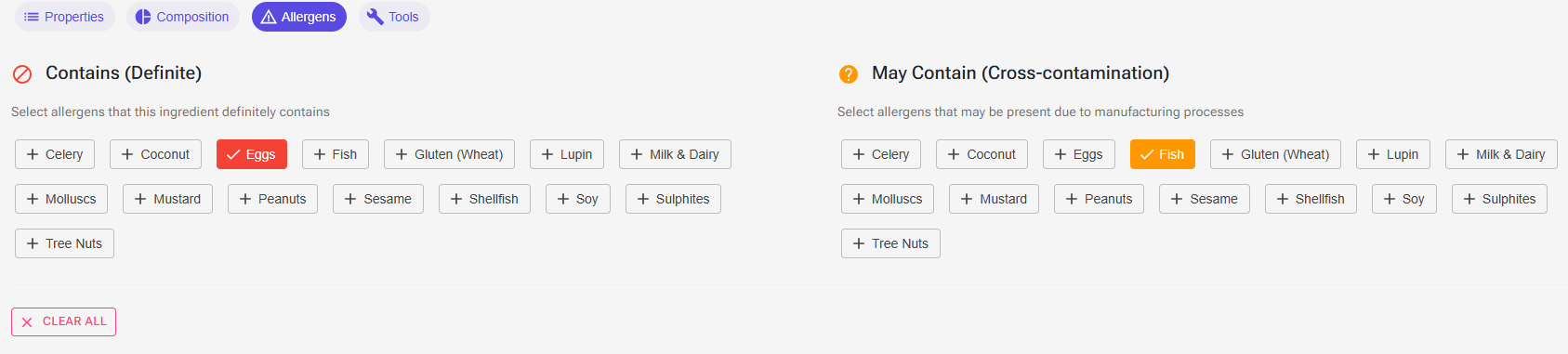
The Allergens tab shows two side-by-side sections for managing allergen information:
- Contains (Definite) — Click allergen chips to toggle them. Selected chips turn red with a checkmark. Includes: Milk & Dairy, Eggs, Tree Nuts, Peanuts, Gluten (Wheat), Soy, Fish, Shellfish, Sesame, Mustard, Celery, Lupin, Molluscs, Sulphites, Coconut.
- May Contain (Cross-contamination) — Same chips but highlighted in amber/orange when selected.
- Clear All button — Resets all allergen selections
- Allergen Summary — An info alert at the bottom shows a text summary of all selected allergens
⚠️ Important: An allergen cannot be in both "Contains" and "May Contain" at the same time. Selecting it in one section automatically removes it from the other.
Tab 4: Tools
The Tools tab shows two large clickable cards:
- Used In Recipes — Opens a dialog showing which of your recipes use this ingredient. The ingredient must be saved first.
- Sub-Ingredients & Labeling — Opens the dedicated page for managing sub-ingredient lists and advanced allergen details for nutrition labels and reports.
2.3 Understanding the Workflow
When You Edit a Shared Ingredient:
- Click Edit on any shared/default ingredient
- You see a "Will Create Personal Copy" chip in the header
- Make your changes
- Click Save
- The system creates a new personal ingredient with your changes
- You are asked if you want to hide the original shared ingredient from your library
- Your recipes will use the new personal ingredient
- Other users still see the original shared ingredient unchanged
When You Edit Your Personal Ingredient:
- Click Edit on your personal ingredient
- Make changes directly
- Click Save
- Changes are saved to the same ingredient
- No new ingredient is created
When You Edit a Recipe-Derived Ingredient:
- Click Edit on a recipe-derived ingredient
- You can change the name, category, and description only
- Nutritional values are controlled by the source recipe
- Click Save — a confirmation dialog explains that only metadata will be saved
- To edit nutritional values, first Unlink the ingredient from its recipe
💡 Tip: If you want to revert a personal ingredient that was originally copied from a shared one, simply delete your personal copy. The original shared ingredient will still be available in the library (unhide it if needed).
2.4 Save Button Behavior
The Save button adapts based on validation status:
- "Save" — Ready to save (green button)
- "Fix X Errors to Save" — Validation errors prevent saving (disabled button)
- "Saving..." — Save in progress (disabled with spinner)
What happens when you save:
- Validation runs automatically
- If errors exist, save is blocked with specific error messages
- If warnings exist, you can still save (warnings are advisory)
- Success message appears after successful save
- You return to the ingredients library
For shared ingredients: First save creates a new personal copy and redirects to the library.
For personal ingredients: Save updates the existing ingredient and returns to the library.
For recipe-derived ingredients: Only metadata (name, category, description) is saved. Nutritional values update from the source recipe.
3. Basic Nutritional Properties
Understanding how ingredient properties work is essential for creating accurate recipes and nutrition labels.
3.1 The Water-Solids-Alcohol Relationship
Every ingredient must satisfy this fundamental equation:
Water + Total Solids + Alcohol = 100%
These three values are automatically balanced:
- Change Water → Total Solids adjusts
- Change Total Solids → Water adjusts
- Change Alcohol → Water adjusts
Examples:
Whole Milk: Water 87.5% + Total Solids 12.5% + Alcohol 0% = 100% ✓
Vodka (40% ABV): Water 60% + Total Solids 0% + Alcohol 40% = 100% ✓
Chocolate (70%): Water 1% + Total Solids 99% + Alcohol 0% = 100% ✓
💡 Pro Tip: The validation system will warn you if these don't balance within 1%. Use the "Balance Water/Solids" quick-fix button to automatically correct any imbalance.
3.2 Total Solids Composition
Total Solids is the sum of all non-water, non-alcohol components:
Total Solids = Total Fat + Total Sugars + Protein + Other Solids + Salt
The system tracks this automatically:
- When you change any component (fat, sugars, protein, etc.), Total Solids recalculates
- When Total Solids changes, Water adjusts to maintain the 100% total
- If components don't match Total Solids, Other Solids is used to balance
Other Solids Explained:
Other Solids is a "catch-all" category for everything not specifically tracked: ash (minerals), unidentified carbohydrates, minor components, and rounding differences.
Example — Whole Milk: Total Solids 12.5% = Total Fat 3.25% + Total Sugars (Lactose) 4.8% + Protein 3.2% + Other Solids 1.25% (minerals, ash) ✓
3.3 Fats
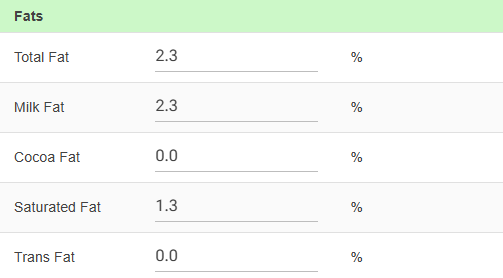
Total Fat
The total amount of all fats in the ingredient (per 100g). This is what appears on nutrition labels.
Fat Subtypes:
Saturated Fat: The portion of total fat that is saturated. Required for nutrition labels. Must be ≤ Total Fat. Examples: Butter is high in saturated fat (~50%), olive oil is low (~14%).
Unsaturated Fat (calculated): Automatically calculated as Total Fat – Saturated Fat – Trans Fat. Includes both monounsaturated and polyunsaturated fats.
Trans Fat: Industrially produced or naturally occurring trans fats. Required for nutrition labels (especially in the US). Usually very small or zero.
Ice Cream Specific Fats:
Milk Fat: Fat from dairy sources. Important for ice cream texture and mouthfeel. Typical range: 0–16% in ice cream recipes. Used in ice cream balancing.
Cocoa Fat (Cocoa Butter): Fat from chocolate/cocoa. Used to calculate the Hardening Factor (HF). Makes ice cream firmer at serving temperature.
Other Fat (calculated): Total Fat – Milk Fat – Cocoa Fat. Includes vegetable oils, nut fats, egg fat, etc. Also used in Hardening Factor calculation.
⚠️ Note: Milk Fat + Cocoa Fat should not exceed Total Fat. The validation system will warn you if this relationship is incorrect.
3.4 Carbohydrates
Regional Differences:
Total Carbohydrates (US definition): Includes fiber. This is what you enter in the system. Appears on US nutrition labels. Formula: Total Sugars + Fiber + Starch + Other Carbs.
Carbohydrates EU (calculated): Excludes fiber. Automatically calculated as Total Carbohydrates – Fiber. Appears on EU nutrition labels.
Carbohydrate Components:
Total Sugars: All sugars (natural and added), including sucrose, glucose, fructose, lactose, maltose, etc. Important: Total Sugars should only include mono- and disaccharides. Most important for ice cream balancing (affects freezing and texture). Used to calculate PAC and POD.
Added Sugars (US nutrition labels only): Sugars added during processing, not including natural sugars (like lactose in milk). Required on US nutrition labels since 2020. Must be ≤ Total Sugars.
Dietary Fiber: Non-digestible carbohydrates (inulin, gums, resistant starch, etc.). Has significant impact on ice cream texture. Affects water binding and scoopability.
Polyols (Sugar Alcohols): Maltitol, sorbitol, xylitol, erythritol, isomalt. Used in sugar-free/reduced sugar products. Has different PAC values than regular sugars. May need to be declared separately on labels.
3.5 Protein
Protein content per 100g of ingredient. Important for ice cream structure and texture. Dairy proteins (casein, whey) behave differently than egg or plant proteins. Used in balancing instead of (or in addition to) MSNF. Typical ice cream: 3–4% protein from dairy.
Why Protein Matters in Ice Cream:
- Stabilizes air bubbles (overrun)
- Provides body and mouthfeel
- Affects melting resistance
- Too much can cause sandy texture
3.6 Nutrition
These values are primarily needed for nutrition label creation:
Salt and Sodium:
Salt: Total salt content (per 100g). Has very high PAC value (freezing point depression). Affects ice cream texture significantly. Formula: Salt (g) = Sodium (mg) × 2.5 / 1000.
Sodium: Elemental sodium content (in mg per 100g). Required for US nutrition labels. Formula: Sodium (mg) = Salt (g) × 1000 / 2.5.
💡 Note: The system validates that salt and sodium values are consistent. If you enter one, you can calculate the other.
Other Minerals (for nutrition labels):
- Cholesterol — In mg per 100g (mainly from dairy and eggs)
- Calcium — In mg per 100g (important in dairy products)
- Iron — In mg per 100g
- Potassium — In mg per 100g
- Vitamin D — In μg (micrograms) per 100g
3.7 Energy (Calories)
Energy is calculated automatically based on macronutrients:
Energy (kcal) = (Carbs – Fiber) × 4 + Protein × 4 + Fat × 9 + Alcohol × 7 + Fiber × 2 + Polyols × 2.4
Energy formats:
- kcal — Kilocalories (also called "Calories" with capital C)
- kJ — Kilojoules (kcal × 4.184)
- Both are displayed in the Nutrition Facts section
3.8 Allergen Information
The system tracks two levels of allergen information:
Contains (Definite):
Allergens that are definitely present as ingredients: Milk & Dairy, Eggs, Tree Nuts, Peanuts, Gluten (Wheat), Soy, Fish, Shellfish, Sesame, Mustard, Celery, Lupin, Molluscs, Sulphites, Coconut.
May Contain (Cross-contamination):
Allergens that may be present due to manufacturing processes or shared equipment.
Managing Allergens:
- Switch to the Allergens tab in the Properties Editor
- Click allergen chips to toggle them on/off
- Red (filled) chips = contained, amber/orange (filled) chips = may contain, grey (outlined) = not selected
- Use Clear All to reset allergen information
- A summary alert at the bottom shows all selected allergens at a glance
⚠️ Important: An allergen cannot be in both "Contains" and "May Contain" at the same time. If you select it in one section, it's automatically removed from the other.
4. Ice Cream Science: PAC, POD & HF
These are the most important properties for ice cream formulation that you won't find on standard nutrition labels.
4.1 PAC (Freezing Point Depression)
[Image placeholder: PAC field in the Settings card showing value and calculator button]
What is PAC?
PAC stands for Potere Anti-Congelante, an Italian term that translates to "anti-freezing power" or freezing point depression factor. It measures how much an ingredient lowers the freezing point of water.
Why it matters:
- Controls ice cream hardness at serving temperature
- Affects scoopability
- Determines how much ice forms vs liquid water
- Critical for texture and mouthfeel
PAC Values (examples per 100g):
| Ingredient | PAC Value | Effect |
|---|---|---|
| Sucrose (table sugar) | 100 | Reference standard |
| Glucose/Dextrose | 190 | Nearly 2x stronger than sucrose |
| Fructose | 190 | Nearly 2x stronger than sucrose |
| Lactose | 100 | Same as sucrose |
| Maltose | 100 | Same as sucrose |
| Higher order sugars | 50–70 | Weaker effect |
| Salt | 585 | Very strong (6x sucrose) |
| Alcohol (ethanol) | 740 | Extremely strong (7x sucrose) |
How PAC is Calculated:
PAC is based on molecular weight and sugar composition. For pure sugars: PAC = (342.3 / molecular weight) × 100, where 342.3 is the molecular weight of sucrose. For mixed ingredients: PAC is the weighted average based on sugar composition.
💡 Example: If an ingredient is 10% sucrose and 5% glucose: PAC = (0.10 × 100) + (0.05 × 190) = 10 + 9.5 = 19.5
Special Cases:
Salt PAC (automatic): Salt PAC is calculated automatically from the Salt field and shows in the read-only "PAC salt" field. Do NOT add salt PAC to the regular PAC field — the system handles salt PAC separately in calculations.
Alcohol PAC: Use the Alcohol button to calculate from volume %. The tool converts volume % to weight % correctly. You must ADD the alcohol PAC to the ingredient's PAC value.
4.2 Using the PAC/POD Calculator
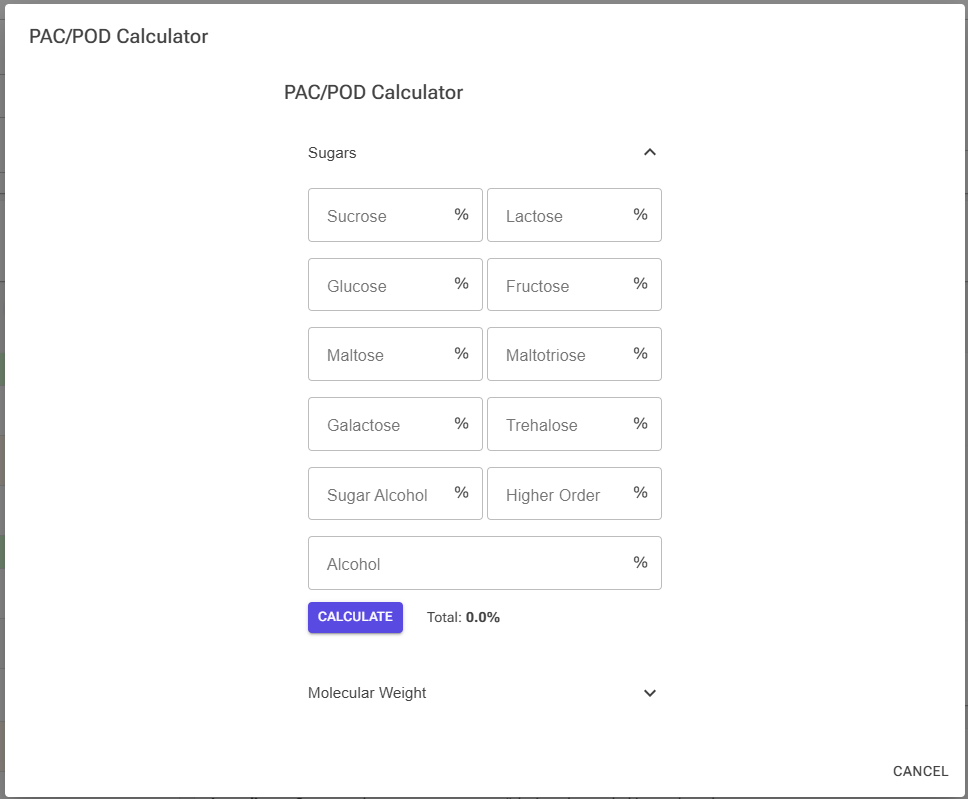
The calculator tool helps you estimate PAC and POD from sugar composition or molecular weight.
Method 1: Sugar Composition
- Click the PAC/POD calculator button (or use Calculate button next to PAC field)
- Enter the percentages for each sugar type in your ingredient
- Fill in: Sucrose, Lactose, Glucose, Fructose, Maltose, Maltotriose, Galactose, Trehalose
- Add Sugar Alcohols (polyols) if present
- Add Higher Order Sugars (maltodextrins, etc.)
- Add Alcohol % if present
- Click Calculate
- The tool shows calculated PAC and POD values
- Click OK to apply to your ingredient
Example — Honey: Fructose 40%, Glucose 35%, Sucrose 2%, Maltose 1% → PAC ≈ 145, POD ≈ 125
Method 2: Molecular Weight
If you know the molecular weight (molar mass) of your ingredient:
- Open PAC/POD calculator
- Switch to Molecular Weight tab
- Enter molar mass in g/mol
- Click Calculate PAC
Formula: PAC = (342.3 / molar mass) × 100
⚠️ Note: POD cannot be calculated from molecular weight alone. It requires relative sweetness data which depends on sugar composition.
4.3 POD (Relative Sweetness)
What is POD?
POD stands for Potere Dolcificante, which translates to sweetening power or relative sweetness. It measures how sweet an ingredient is compared to sucrose.
Why it matters:
- Balance sweetness across different sugar types
- Substitute sugars while maintaining sweetness
- Create consistent sweetness in recipes
- Important for sugar reduction strategies
POD Values (examples per 100g):
| Sugar Type | POD Value | Relative Sweetness |
|---|---|---|
| Sucrose | 100 | Reference (100%) |
| Fructose | 170 | 1.7x sweeter |
| Glucose | 77 | 0.77x as sweet |
| Lactose | 16 | 0.16x as sweet (barely sweet) |
| Maltose | 40 | 0.4x as sweet |
| Maltotriose | 30 | 0.3x as sweet |
| Higher order sugars | 20 | 0.2x as sweet |
| Sugar alcohols | 25–90 | Varies by type |
How POD is Calculated:
Similar to PAC, POD is calculated from sugar composition: POD = (% sugar₁ × POD₁) + (% sugar₂ × POD₂) + …
💡 Example: Invert sugar (50% glucose, 50% fructose): POD = (0.50 × 77) + (0.50 × 170) = 38.5 + 85 = 123.5 — meaning 1.23x sweeter than sucrose.
Using POD in Practice — Sweetness Equivalents:
- 100g sucrose (POD 100) = 59g fructose (POD 170)
- 100g sucrose (POD 100) = 130g glucose (POD 77)
- 100g sucrose (POD 100) = 625g lactose (POD 16)
This means you can substitute sugars while maintaining the same sweetness level by adjusting the amounts based on POD values.
4.4 HF (Hardening Factor)
What is HF?
HF or Hardening Factor measures how much an ingredient makes ice cream firmer/harder at serving temperature. It's essentially a "negative PAC" — while PAC softens ice cream, HF hardens it.
Why it matters:
- Chocolate makes ice cream harder (more frozen water)
- Nuts and nut pastes increase firmness
- Must compensate with more PAC (sugars) or higher fat
- Critical for chocolate and nut-based ice creams
How HF is Calculated:
The system uses this formula based on Corvitto's research:
HF = (Cocoa Fat × 0.9) + (Cocoa Solids × 1.8) + (Other Fat × 1.4)
Components:
- Cocoa Fat — Cocoa butter from chocolate (coefficient: 0.9)
- Cocoa Solids — Dry cocoa particles (coefficient: 1.8 — strongest effect)
- Other Fat — Non-dairy, non-cocoa fats like nut oils (coefficient: 1.4)
Example — 70% Dark Chocolate: Cocoa Fat 39%, Cocoa Solids 31% → HF = (0.39 × 0.9) + (0.31 × 1.8) = 0.351 + 0.558 = 0.909 → Displayed as: 90.9
Using the HF Calculator:
- Click the HF calculator button (or Calculate next to HF field)
- System automatically calculates from Cocoa Fat, Cocoa Solids, and Other Fat
- Click OK to apply
💡 Pro Tip: When adding chocolate to ice cream, you need to increase PAC (add more sugars) to compensate for the hardening effect. A common rule: for every 10% chocolate, add 1–2% extra sugar.
5. Dairy-Specific Properties
For dairy ingredients, the system tracks additional properties important for ice cream making.
5.1 MSNF (Milk Solids Not Fat)
What is MSNF?
MSNF stands for "Milk Solids Not Fat" (also called "serum solids" or "milk solids non-fat").
MSNF includes: Lactose (milk sugar) ~54.5%, Milk proteins (casein + whey) ~36%, Minerals and ash ~9.5%.
Formula: MSNF = Total Solids – Milk Fat (or more detailed: MSNF = Lactose + Protein + Other Solids)
Why MSNF Matters:
- Traditional ice cream balancing parameter
- Provides body and texture
- Typical ice cream: 9–12% MSNF
- Too high: sandy texture from lactose crystallization
- Too low: weak body, icy texture
5.2 Milk Fat vs Total Fat
Milk Fat: Fat specifically from dairy sources (butter, cream, whole milk, etc.). Typical ice cream: 10–16% milk fat. Creates characteristic dairy flavor and mouthfeel.
Relationship: Milk Fat ≤ Total Fat. Total Fat = Milk Fat + Cocoa Fat + Other Fat.
5.3 Lactose
What is Lactose?
Lactose is the natural sugar found in milk and dairy products.
Why track it separately:
- Can crystallize if too high (causes sandy texture)
- Maximum recommended: ~9% of water content
- Has specific PAC value (100, same as sucrose)
- Low sweetness (POD = 16)
- Important for lactose-intolerant customers
Lactose in Common Dairy:
| Ingredient | Lactose % |
|---|---|
| Skim milk | ~5.0% |
| Whole milk | ~4.8% |
| Heavy cream | ~3.1% |
| Skim milk powder | ~52% |
| Whey powder | ~70% |
| Butter | ~0.1% |
6. Chocolate-Specific Properties
Chocolate ingredients require special attention due to their unique impact on ice cream texture.
6.1 Understanding Chocolate Composition
Chocolate Components:
- Cocoa Mass — Ground roasted cocoa beans (contains both fat and solids)
- Cocoa Butter — Fat extracted from cocoa beans (Cocoa Fat)
- Cocoa Solids — Dry particles after removing cocoa butter
- Sugar — Added sweetener
- Milk Solids — In milk chocolate only
Chocolate Percentage:
The "%" on chocolate labels (e.g., 70% dark chocolate) refers to: Chocolate % = Cocoa Solids + Cocoa Fat. The remaining percentage is sugar (and milk solids for milk chocolate).
6.2 Cocoa Solids
Cocoa Solids are the dry, non-fat particles from cocoa beans. They provide chocolate flavor, strongly increase Hardening Factor (coefficient: 1.8), absorb water, and make ice cream firmer at serving temperature.
Estimating Cocoa Solids:
If you have a technical data sheet, use the provided cocoa solids value directly. If you only know chocolate % and fat %: Cocoa Solids = Chocolate % – Cocoa Fat %. If you only know chocolate % (no fat data): for dark chocolate, assume Cocoa Solids ≈ Cocoa Fat ≈ Chocolate % / 2.
6.3 Cocoa Fat (Cocoa Butter)
Cocoa Fat is the natural fat extracted from cocoa beans. It has a unique melting profile (melts cleanly at body temperature), contributes to chocolate snap and mouthfeel, and increases Hardening Factor (coefficient: 0.9).
Cocoa Fat in Different Products:
| Product | Typical Cocoa Fat % |
|---|---|
| Cocoa powder (10–12% fat) | 10–12% |
| Cocoa powder (20–24% fat) | 20–24% |
| 70% dark chocolate | 35–42% |
| Milk chocolate (35%) | 15–20% |
| Cocoa butter (pure) | 100% |
6.4 Working with Chocolate in Ice Cream
The Hardening Problem:
Chocolate makes ice cream firmer because cocoa solids absorb water, cocoa fat has a different crystallization behavior, and more water freezes at serving temperature — resulting in rock-hard ice cream.
Solutions:
- Increase PAC — Add more sugars (especially glucose/dextrose). Rule of thumb: +1–2% sugar per 10% chocolate.
- Increase fat — Add cream or milk fat. Fat doesn't freeze and keeps texture softer.
- Use cocoa powder instead — Less fat = less hardening. 10–12% fat cocoa powder has less impact than chocolate.
💡 Pro Tip: When formulating chocolate ice cream, always use the HF calculator and compensate with extra PAC. The validation system will show you if your chocolate content is causing balance issues.
7. Validation & Quality Checks
The validation system helps ensure your ingredient data is accurate and consistent. Validation happens inline within the Properties table — each field with an issue shows a small icon you can click for details.
7.1 Understanding Validation Levels
Error (Red — Must Fix):
Prevents saving the ingredient. Data is logically impossible or would cause calculation errors. Examples: saturated fat exceeding total fat, min amount exceeding max amount, component solids exceeding total solids.
Warning (Orange — Should Review):
Allows saving but indicates potential issues. Data may be unusual or inconsistent. Examples: milk fat + cocoa fat exceeding total fat, MSNF mismatch with calculated value, total solids components not balanced.
Info (Blue — Suggestions):
Advisory information to help improve data quality. Examples: lactose exceeding total sugars, carbohydrates less than sugars + fiber, salt/sodium values not matching expected conversion.
7.2 How Inline Validation Works
When a field has a validation issue:
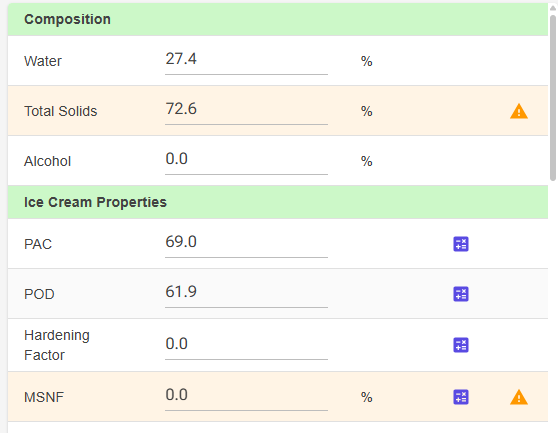
- The table row background changes color to highlight the problem
- A small icon button appears in the rightmost column — red for errors, orange for warnings, blue for info
- Click the icon to open a popover with the specific issue message
- Where applicable, the popover includes quick-fix buttons that correct the issue with one click
Available Quick-Fix Actions:
- "Set to Total Fat" — When saturated fat exceeds total fat
- "Calc Sodium" / "Calc Salt" — When salt and sodium values are inconsistent, calculate one from the other
- "Swap values" — When min amount exceeds max amount
The Composition tab provides additional balancing tools: "Calculate Other Solids" adjusts Other Solids so that all solid components sum correctly, and "Recalculate Total Solids" rebuilds Total Solids from all components.
7.3 Common Validation Issues
1. Water/Solids Balance
Issue: "Water + Total Solids + Alcohol ≠ 100%"
Cause: Values don't sum correctly.
Quick Fix: Click the "Balance Water/Solids" button to automatically adjust Water to make the total 100%.
2. Negative Values
Issue: "Water cannot be negative (currently -2.5g)"
Cause: Total Solids + Alcohol exceeds 100%.
Quick Fix: Click "Set to 0" button for the negative field. Then reduce Total Solids or Alcohol, or check if you entered percentages instead of decimals.
3. Total Solids Composition
Issue: "Total Solids (35g) vs. sum of components (42g) — check if values balance"
Cause: Fat + Sugars + Protein + Other Solids + Salt ≠ Total Solids.
Solutions: Let the system recalculate Total Solids from components, adjust Other Solids to balance, or check for data entry errors.
4. Fat Relationships
Issue: "Saturated Fat (45g) cannot exceed Total Fat (36g)"
Cause: Component fat exceeds total.
Quick Fix: Click "Set to Total Fat" button, or reduce saturated fat, or increase total fat if the saturated value is correct.
5. Salt/Sodium Relationship
Issue: "Salt/Sodium relationship: 1.1g salt ≈ 440mg sodium (entered: 95mg)"
Cause: Salt and sodium values are inconsistent.
Information: This is INFO level, not an error. Formula: Sodium (mg) = Salt (g) × 400 (or Salt (g) = Sodium (mg) / 400). Decide which value is correct and adjust the other to match.
6. Lactose Crystallization Risk
Issue: "High lactose content may cause crystallization during storage"
Cause: Lactose exceeds ~9% of water content.
Explanation: Maximum lactose solubility in water is ~9%. Above this, lactose may crystallize during storage, resulting in sandy texture.
Solutions: Use skim milk powder instead of whey powder, reduce dairy ingredients, use lactose-free milk, or accept the risk if storage time will be short.
Summary
You've now learned the complete ingredient system:
- Ingredient Library — Browse, search, filter by category/source/usage/collections, hide/show, organize with collections, and bulk-manage ingredients
- Creating & Editing — Multiple methods to add ingredients, understanding the personal copy workflow, tools for sub-ingredients and recipe usage
- Basic Properties — Water, solids, fats, carbohydrates, proteins, and their relationships
- Ice Cream Science — PAC (freezing), POD (sweetness), HF (hardening)
- Dairy Properties — MSNF, milk fat, lactose tracking
- Chocolate Properties — Cocoa solids, cocoa fat, and managing hardening effects
- Validation — Understanding errors, warnings, and how to fix common issues
Last updated: April 2026
Version: 2.0